

saudigastro.com/patients/zenker-diverticulum
Category
Chronic
Red flags
4
This article is educational and does not replace your doctor's advice. Seek urgent care for any red-flag symptoms.
What is it?
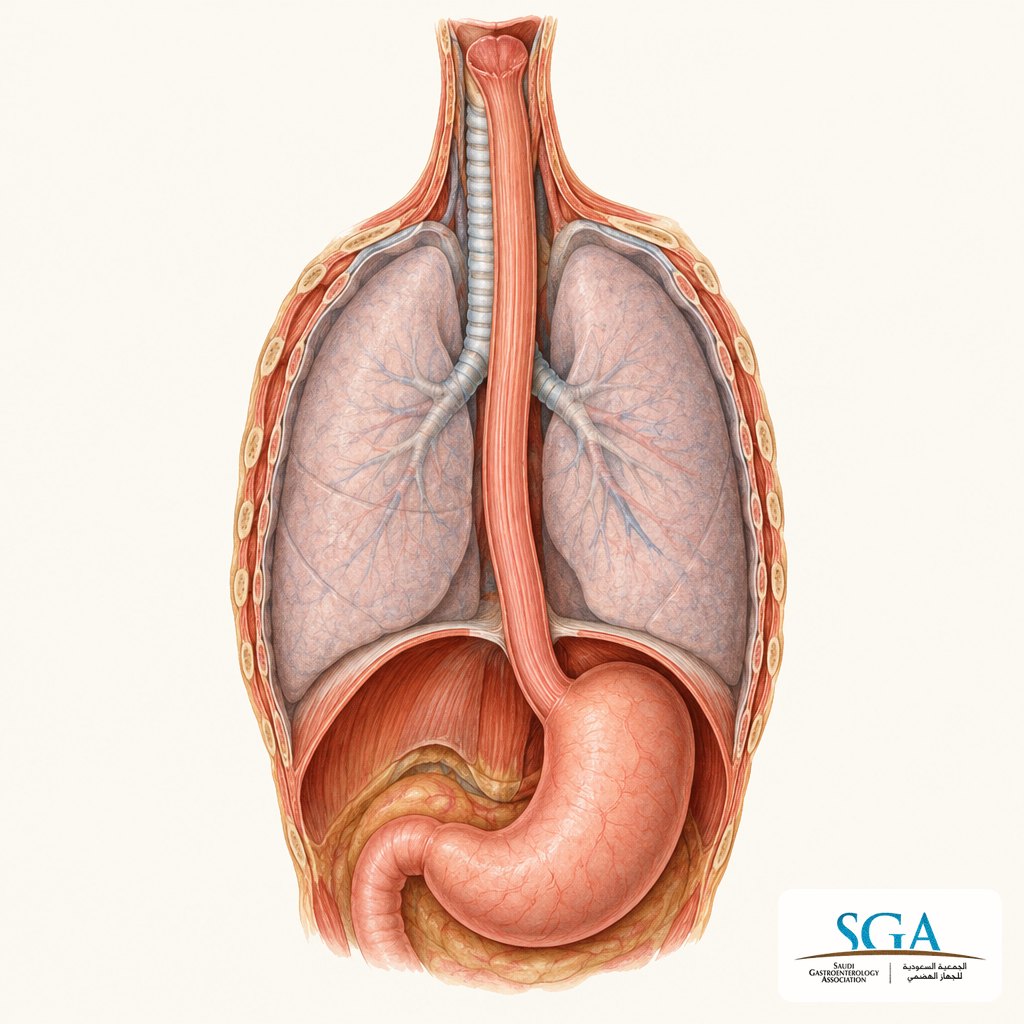
The esophagus (the food pipe) carries food from the throat to the stomach. At its very top there is a ring-like muscle that relaxes to let food pass. In a Zenker diverticulum, the lining of the throat bulges out through a weak spot just above this muscle and forms a pouch (a diverticulum is simply a small outpouching). Food, pills and saliva can fall into the pouch and stay there, then come back up later, sometimes hours after a meal.
How common is it?
It is uncommon. It is seen mostly in older adults and is rare in young people. Many small pouches cause no symptoms and are found by chance.
Why does it happen?
The exact cause is not fully understood. The leading explanation is that the muscle at the top of the esophagus does not relax well enough while swallowing, so pressure builds up above it and pushes the lining outward through a weak area over many years. This is why it appears mostly later in life. It is not caused by something you ate or did.
Symptoms
- Difficulty swallowing (dysphagia), with food feeling stuck high in the neck
- Regurgitation of undigested food or saliva, sometimes hours after eating or when lying down
- Bad breath from food sitting in the pouch
- Gurgling noises in the neck when swallowing
- Frequent throat clearing, a lump in the throat or a chronic cough
- Weight loss in longer-standing cases because eating becomes difficult
Red flags — seek urgent medical care
Coughing, choking or fever after meals, or repeated chest infections
Regurgitated food may be going into the lungs (aspiration). See a doctor soon; if you have trouble breathing, go to the emergency department.
Food or a pill completely stuck, with inability to swallow even saliva
This is an emergency. Go to the emergency department now.
Unplanned weight loss or being unable to eat enough
You may need treatment sooner and a check for other causes. See your doctor.
Vomiting blood or black stools
Possible bleeding. Seek urgent care.
How is it diagnosed?
The usual test is a barium swallow: you drink a safe liquid that shows up on X-ray, and the pouch appears as a bulge at the top of the esophagus. Endoscopy (a thin flexible camera passed through the mouth) may be done to look for other problems, but it must be done carefully because the camera can accidentally enter the pouch. Tell the doctor if you already know you have a Zenker diverticulum before any endoscopy.
Outlook — what to expect
A Zenker diverticulum does not go away on its own and tends to slowly grow. Small pouches without symptoms can simply be watched. When symptoms are troublesome, treatment is usually effective and most people swallow much better afterwards. Cancer arising in the pouch is very rare.
Treatment
Habits & Lifestyle
Small habits can reduce food collecting in the pouch while you wait for or recover from treatment.
- Eat slowly and chew well
- Sit upright while eating and for a while afterwards
- Avoid lying down soon after meals and raise the head of the bed if you regurgitate at night
- Drink a little water after meals to help wash out the pouch
Diet
Softer foods usually pass more easily.
- Choose smaller, more frequent meals
- Moisten dry foods with sauces or broth
- Cut food into small pieces; avoid tough meat and dry bread if they get stuck
- If weight is dropping, ask for dietitian advice
Medications
No medicine can remove the pouch or fix the underlying cause.
- Medicines do not treat a Zenker diverticulum itself
- Take tablets with plenty of water and sitting upright, as pills can get trapped in the pouch
- Tell your doctor if a tablet seems to get stuck; they can suggest liquid forms where suitable
Procedures & Surgery
Treatment is considered when symptoms affect eating, weight or breathing. Your doctor will choose the method that suits your age, health and the size of the pouch.
- Flexible endoscopic treatment: the muscle wall between the pouch and the esophagus is divided through the mouth, with no skin cut. Recovery is usually quick
- Rigid endoscopic treatment is a similar approach using a firm scope under general anesthesia
- Open surgery through the neck may be preferred for some pouches
- A pouch that causes no symptoms may just be watched
Questions to ask your doctor
Save this list or print it before your appointment — doctors appreciate prepared patients.
- Do I need treatment, or can the pouch be watched?
- Which treatment do you recommend for me and why?
- What are the risks of the procedure and how long is recovery?
- Could the pouch come back after treatment?
- Is there anything I should avoid before other endoscopy tests?
Was this guide helpful?
Status: Approved for publication by SGA; individual clinician review is ongoing · Published 24/04/2026
For general education only; it does not replace your doctor’s advice. Individual clinician review of this guide is ongoing. SGA clinician? Review this guide