

saudigastro.com/patients/small-bowel-obstruction
Category
Serious
Red flags
5
This article is educational and does not replace your doctor's advice. Seek urgent care for any red-flag symptoms.
What is it?
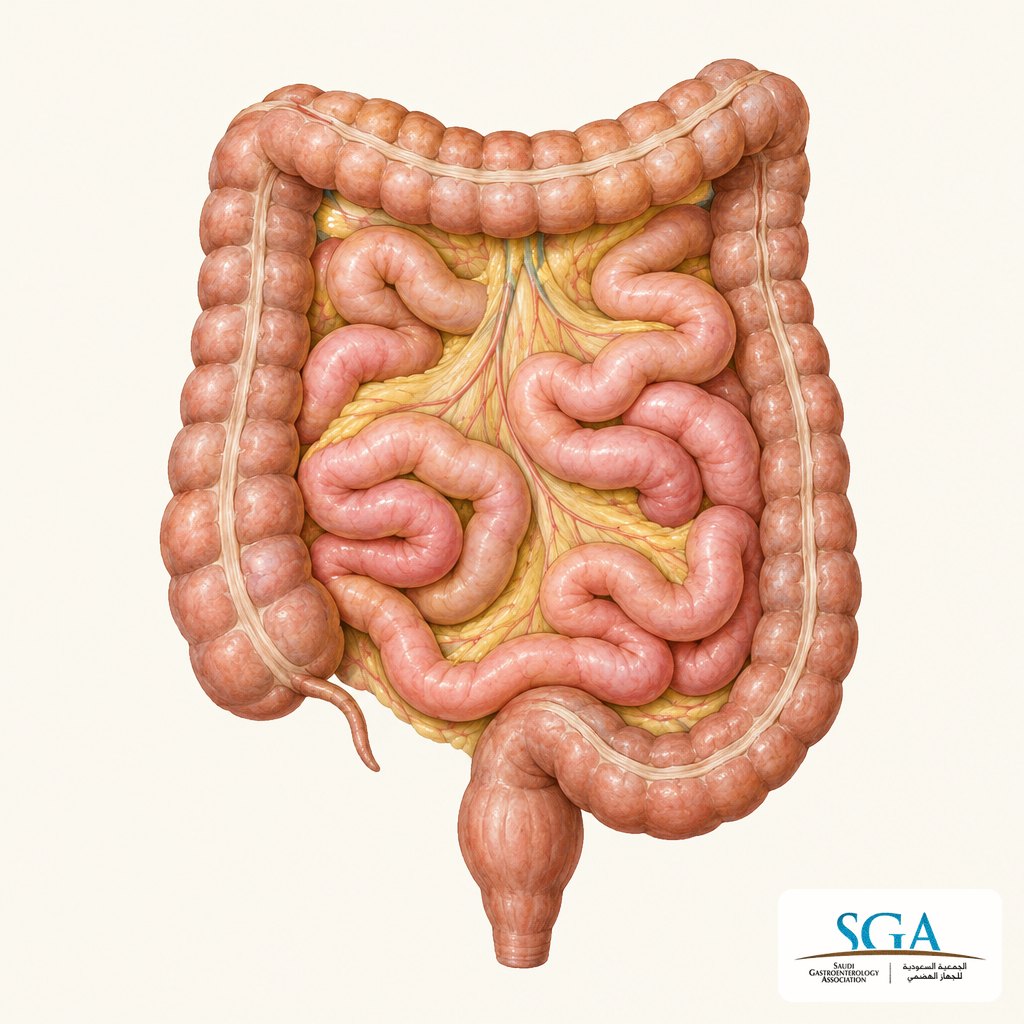
The small bowel is the long tube between the stomach and the colon, where most food is digested and absorbed. In a small bowel obstruction, something blocks the tube, either partly or completely. Food, fluid and gas build up behind the blockage, causing pain, swelling and vomiting. The most common cause in adults is scar tissue (adhesions) after previous belly surgery. If the blood supply to the trapped bowel is cut off, the bowel can be damaged, which is why this can become an emergency.
How common is it?
It is a frequent reason for emergency admission with belly pain, especially in people who have had abdominal or pelvic surgery. It can occur years after the operation. Some people have a single episode, while others have repeated episodes.
Why does it happen?
Besides adhesions (bands of scar tissue), causes include hernias (when a loop of bowel is trapped in a weak spot of the belly wall), tumours, Crohn's disease narrowing, twisting of the bowel, and less commonly swallowed objects or gallstones. Some people have a "functional" slowdown of the bowel without a physical blockage, called ileus, which is managed differently. Your doctor will work out which one you have.
Symptoms
- Crampy belly pain that comes in waves
- Vomiting, which may become greenish or foul-smelling later
- A swollen, bloated belly
- Not passing gas or stool (complete blockage), or passing small amounts of watery stool (partial blockage)
- Loss of appetite and feeling very thirsty
- Loud bowel sounds early on, which may quieten later
Red flags — seek urgent medical care
Severe or constant belly pain that does not come and go
Could mean the bowel is losing its blood supply. Go to the emergency department immediately.
Repeated vomiting or unable to keep any fluid down
Risk of dehydration and a blockage that needs hospital care. Seek emergency care now.
Fever, fast heartbeat, or a hard, very tender belly
Possible infection or damaged bowel. This is an emergency.
A painful, firm lump in the groin or belly wall that cannot be pushed back
A trapped hernia. Needs urgent surgical assessment.
Dizziness, very little urine or fainting
Signs of dehydration or shock. Seek emergency care.
How is it diagnosed?
The doctor asks about your symptoms and previous operations and examines your belly. Blood tests check for dehydration, infection and salt imbalance. A CT scan of the belly is the most useful test: it usually shows where the blockage is, how severe it is and whether the bowel is at risk. A plain X-ray or ultrasound is sometimes used first.
What the latest science says
Many partial blockages settle with a trial of non-operative care in hospital. Doctors review the patient repeatedly, and surgery is advised if there are signs the bowel is in danger or if the blockage does not improve. In some centres a water-soluble contrast drink is used both to help show the blockage and to help it clear.
Outlook — what to expect
With timely care, most people recover well. Many partial blockages resolve without surgery, although they can come back. Delay in seeking care increases the chance of bowel damage and a more complicated recovery.
Treatment
Habits & Lifestyle
A suspected blockage should not be treated at home. Go to the emergency department. After recovery, a few habits may help reduce the risk of repeat episodes.
- Do not use laxatives, enemas or home remedies if you have vomiting, a swollen belly and cannot pass gas.
- Know your history: keep a record of past operations and tell every doctor about them.
- Have a hernia repaired when advised, rather than waiting for it to become trapped.
- Eat slowly and chew well, especially if you have a known narrowing.
- Go to hospital early if an episode starts, since earlier care is safer.
Diet
During a blockage you will usually be told not to eat or drink and may be given fluids through a vein. Afterwards, food is reintroduced gradually.
- Restart eating only when your medical team says it is safe, usually starting with fluids and soft foods.
- If you have a known narrowing, ask whether to limit very fibrous or stringy foods (such as tough skins, seeds, nuts and gristly meat).
- Small, frequent meals are usually better tolerated than large ones.
- Drink enough fluids unless your doctor has limited them.
Medications
Medicines support recovery but do not remove a mechanical blockage. They are chosen by the hospital team.
- Fluids and salts are given through a vein to treat dehydration.
- Anti-sickness medicines and pain relief may be given; some pain medicines slow the bowel, so the team chooses carefully.
- Antibiotics are used if infection or bowel damage is suspected.
- Do not take laxatives or anti-diarrhea medicines for this problem unless a doctor tells you to.
Procedures & Surgery
Some people need a procedure to relieve the blockage or surgery to fix its cause.
- A thin tube passed through the nose into the stomach (nasogastric tube) can drain fluid and gas and relieve vomiting.
- Surgery cuts scar bands, repairs a hernia or removes a damaged or blocked section of bowel.
- Surgery is usually needed urgently when the bowel is at risk or the blockage is complete and not improving.
- Cancer or Crohn's disease causes need specific treatment planned by the specialist team.
Living with the condition
- If you have had one blockage, you may be at risk of another. Know the warning symptoms and act early.
- Keep a short note of your surgical history to show in the emergency department.
Questions to ask your doctor
Save this list or print it before your appointment — doctors appreciate prepared patients.
- What caused my blockage?
- Is there a chance it will come back, and how can I lower it?
- Do I need surgery now or later?
- Are there foods I should avoid?
- Which symptoms mean I should come straight back to hospital?
Was this guide helpful?
Status: Approved for publication by SGA; individual clinician review is ongoing · Published 24/04/2026
For general education only; it does not replace your doctor’s advice. Individual clinician review of this guide is ongoing. SGA clinician? Review this guide