

saudigastro.com/patients/pancreatic-neuroendocrine-tumors
Category
Serious
Red flags
5
This article is educational and does not replace your doctor's advice. Seek urgent care for any red-flag symptoms.
What is it?
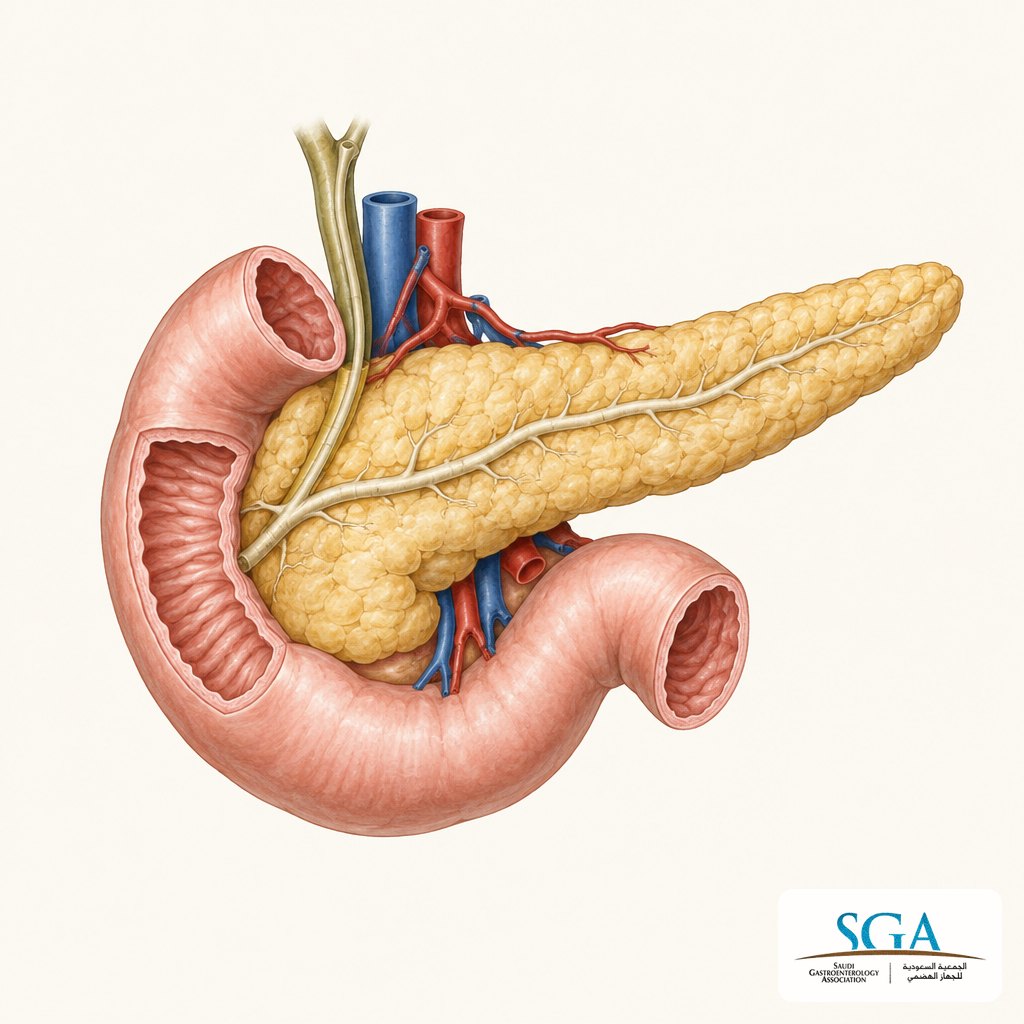
The pancreas contains small groups of hormone-producing cells (islet cells) that make insulin, glucagon and other hormones. Pancreatic neuroendocrine tumours (PanNETs) grow from these cells. They are different from pancreatic ductal adenocarcinoma, the more common and more aggressive pancreatic cancer. Some PanNETs make extra hormones and cause specific symptoms (functioning tumours), for example too much insulin causing low blood sugar; many do not make hormones (non-functioning) and may be found only when they grow large or by chance on a scan. They range from slow-growing to more aggressive, and this is described by a grade and stage.
How common is it?
PanNETs are uncommon, but they are being found more often because scans are used more widely. Most occur by chance without a clear cause. A small number are linked to inherited syndromes such as MEN1, von Hippel-Lindau disease, neurofibromatosis type 1 or tuberous sclerosis, so a family history is important to mention.
Why does it happen?
The cause is usually unknown. Changes (mutations) occur in the genes of islet cells, either by chance or, in a small number, inherited from a parent. Nothing you ate or did caused the tumour. Because some forms run in families, your doctor may offer genetic counselling or testing, especially if you are young, have several tumours, or have relatives with similar tumours.
Symptoms
- Many people have no symptoms; the tumour is found by chance
- Upper abdominal pain, back pain or a feeling of fullness (larger non-functioning tumours)
- Yellow skin or eyes, or weight loss, if the tumour presses on the bile duct
- Insulin-making tumour: episodes of sweating, shakiness, confusion, hunger or fainting that improve after eating
- Gastrin-making tumour: stomach ulcers and persistent diarrhoea or heartburn
- Other hormone syndromes: severe watery diarrhoea, flushing, or a rash with raised blood sugar
Red flags — seek urgent medical care
Fainting, confusion, a seizure, or episodes of severe shakiness and sweating that do not improve with sugar
Dangerously low blood sugar. Call emergency services immediately.
Vomiting blood or black stools
Bleeding from an ulcer or the tumour. Go to the emergency room now.
Severe abdominal pain that does not settle, or repeated vomiting
Possible blockage or complication. Seek emergency care.
Yellow eyes or skin with fever and chills
An infected, blocked bile duct is an emergency. Go to hospital immediately.
Severe, persistent watery diarrhoea with weakness, dizziness or very little urine
Dehydration and low potassium can be dangerous. Seek urgent care.
How is it diagnosed?
Diagnosis is made by scans and tissue testing. CT or MRI show the tumour and whether it has spread, often to the liver. Endoscopic ultrasound allows a close look and a needle sample (biopsy) so the tumour can be graded under the microscope. Special nuclear medicine scans (such as a PET or SPECT scan using a tracer that attaches to these tumour cells) help to find the extent of disease. Blood and urine tests for hormones and markers such as chromogranin A may be done, and a fasting test is used if an insulin-producing tumour is suspected. Cases are best discussed by a specialist team (MDT).
What the latest science says
Treatment has expanded in recent years. Besides surgery, options include somatostatin analogue injections that slow tumour growth and control hormone symptoms, targeted drugs, chemotherapy, and peptide receptor radionuclide therapy (PRRT), a treatment that delivers radiation directly to tumour cells. The best sequence depends on the grade, the stage and the patient. Small non-functioning tumours that are found by chance are sometimes watched with scans rather than operated on straight away.
Outlook — what to expect
The outlook varies widely. Many PanNETs grow slowly, and people can live for many years, especially if the tumour can be removed completely. More aggressive or widespread tumours need long-term treatment and monitoring. Your specialist team can explain what the grade and stage mean for you personally; it is not possible to give a general figure that applies to everyone.
Treatment
Habits & Lifestyle
Daily habits do not treat the tumour but help you stay as well as possible during care.
- Go to all scans, blood tests and clinic visits; follow-up is long term.
- If you have an insulin-making tumour, learn the signs of low blood sugar and always carry fast-acting sugar.
- Do not smoke and avoid alcohol, which add to pancreatic and general health risks.
- Stay as active as you can; gentle exercise helps energy and mood.
- Share your family history with your doctor, and ask about genetic counselling if recommended.
Diet
Nutrition matters, particularly after surgery or if you have diarrhoea or weight loss. A dietitian experienced in tumours and pancreatic disease is very helpful.
- Eat small, regular meals with enough protein and calories.
- With an insulin-making tumour, frequent meals and snacks with slow-release carbohydrate help to prevent low blood sugar.
- Drink enough fluid if you have diarrhoea; your team may check your salts and vitamins.
- If the pancreas is not digesting food well (after surgery or treatment), enzyme capsules taken with meals can help.
- Avoid unproven "cancer diets" and supplements; discuss them with your team first.
Medications
Medicines are chosen by a specialist team and depend on the tumour type, grade and spread. Doses and schedules are set by your doctor.
- Somatostatin analogue injections can slow tumour growth and reduce hormone-related symptoms such as flushing or diarrhoea.
- Targeted medicines or chemotherapy may be used for more advanced or faster-growing tumours.
- Medicines to raise blood sugar or reduce insulin release may be used for insulin-making tumours before surgery.
- Acid-lowering medicine controls ulcers and diarrhoea in gastrin-making tumours.
- Report side effects early, including fever during chemotherapy, which needs urgent attention.
Procedures & Surgery
Surgery is the only treatment that can cure PanNETs when they can be fully removed. Other procedures help to control disease that has spread.
- Surgery removes the tumour, and sometimes part of the pancreas, spleen or nearby lymph nodes.
- Small tumours may be removed with keyhole surgery or sometimes watched with regular scans.
- Spread to the liver may be treated by surgery, ablation (heat or other energy to destroy tumour tissue) or blocking the blood supply to the tumour.
- Peptide receptor radionuclide therapy (PRRT) is given at specialised centres for suitable patients.
- After surgery you may need enzymes or diabetes treatment; your team will explain.
Living with the condition
- A diagnosis of a tumour can be frightening; ask for support from a nurse specialist, psychologist or patient groups.
- Bring a family member to appointments and write down questions beforehand.
- Ask whether relatives should be checked if an inherited syndrome is found.
Questions to ask your doctor
Save this list or print it before your appointment — doctors appreciate prepared patients.
- What are the grade and stage of my tumour, and what do they mean?
- Is it a functioning tumour, and which hormone is involved?
- Is surgery, watching with scans, or medicine best for me?
- Should I have genetic testing, and should my relatives be checked?
- Has my case been discussed by a multidisciplinary team at a specialist centre?
Was this guide helpful?
Status: Approved for publication by SGA; individual clinician review is ongoing · Published 24/04/2026
For general education only; it does not replace your doctor’s advice. Individual clinician review of this guide is ongoing. SGA clinician? Review this guide