

saudigastro.com/patients/nsaid-gastropathy
Category
Common
Red flags
5
This article is educational and does not replace your doctor's advice. Seek urgent care for any red-flag symptoms.
What is it?
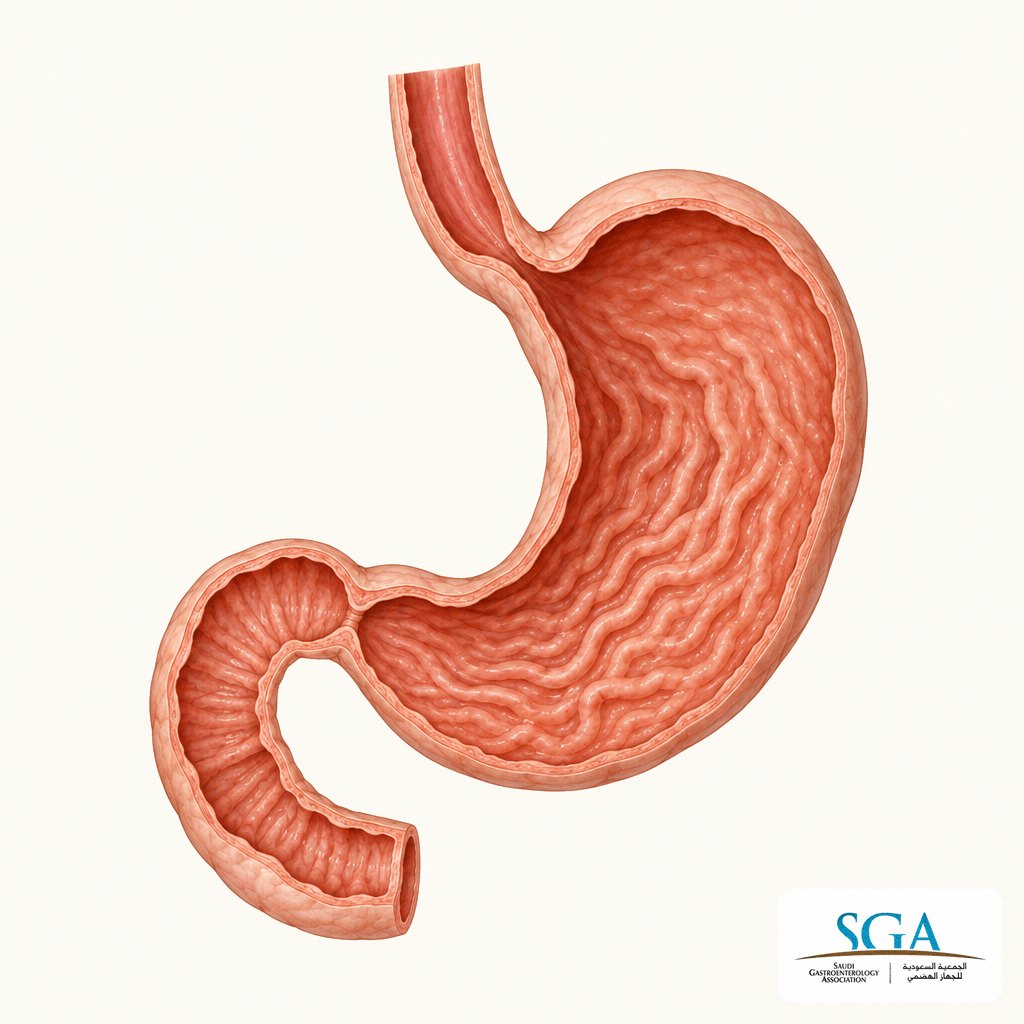
NSAIDs (non-steroidal anti-inflammatory drugs) are widely used painkillers such as ibuprofen, diclofenac, naproxen and aspirin. They reduce pain and inflammation, but they also lower the substances (prostaglandins) that help protect the stomach lining from acid. As a result, the lining can become inflamed (gastropathy or gastritis), develop erosions (shallow sores), or form ulcers (deeper sores). Many people have no symptoms until a complication such as bleeding occurs.
How common is it?
Stomach irritation from NSAIDs is common, particularly with regular or long-term use. The risk is higher in older adults, in people who have had an ulcer before, and in those who also take blood thinners, steroids or aspirin. Many NSAIDs can be bought without a prescription, so people may not realise how often they take them.
Why does it happen?
NSAIDs reduce protective mucus and blood flow in the stomach lining and directly irritate it. The risk rises with higher amounts, longer use, taking more than one NSAID, older age, alcohol, smoking, and infection with Helicobacter pylori (H. pylori, a stomach germ). Even low-dose aspirin taken for the heart can cause problems. Different NSAIDs carry different risks, so your doctor can choose the most suitable one.
Symptoms
- Upper belly pain or burning, often after eating
- Indigestion, bloating and feeling full quickly
- Nausea or heartburn
- Loss of appetite
- Tiredness and paleness from slow, hidden bleeding (anemia means low red blood cells)
- No symptoms at all in many people
Red flags — seek urgent medical care
Black, tar-like, sticky or bloody stool
Sign of bleeding in the stomach. Go to the emergency department now.
Vomiting blood or material that looks like coffee grounds
Active bleeding. Call emergency services or go to the hospital immediately.
Sudden, severe, constant belly pain with a rigid belly
May mean the ulcer has made a hole (perforation). This is an emergency.
Dizziness, fainting, a racing heart or severe weakness
Possible significant blood loss. Seek emergency care.
Repeated vomiting, or difficulty swallowing, or unintended weight loss
Needs prompt medical review to find the cause.
How is it diagnosed?
Your doctor will ask which painkillers you use, including those bought without a prescription and herbal products. Blood tests check for anemia. A test for H. pylori (breath, stool or biopsy) is usually done. An upper endoscopy (a thin flexible camera passed through the mouth under sedation) can show inflammation, erosions or ulcers and can treat bleeding, and tiny tissue samples may be taken. Not everyone needs an endoscopy; it is more likely if you are older or have warning signs.
What the latest science says
Guidelines support protecting the stomach with acid-suppressing medicine (such as proton pump inhibitors) in people who must continue NSAIDs and are at higher risk, and testing and treating H. pylori in people starting long-term NSAIDs. Some NSAIDs and non-NSAID options carry lower stomach risk but may have other risks, so the choice is individual.
Outlook — what to expect
Most people heal well once the NSAID is stopped or changed and the stomach is protected. Ulcers usually heal in weeks with treatment. The most serious risk is bleeding, which is why early review and prevention in higher-risk people matter.
Treatment
Habits & Lifestyle
Safe use of painkillers is the most powerful prevention.
- Use the lowest amount for the shortest time, and only as your doctor or pharmacist advises.
- Do not combine two NSAIDs. Check labels of cold and flu products and gels or tablets for hidden NSAIDs.
- Take NSAIDs with food, and do not lie down right after taking tablets.
- Avoid alcohol and stop smoking; both damage the stomach lining.
- Never stop low-dose aspirin prescribed for your heart or stroke prevention without speaking to your doctor.
Diet
No special diet heals the stomach, but some habits can reduce symptoms.
- Eat regular, smaller meals if large meals worsen discomfort.
- Limit foods that you notice trigger pain, such as very spicy, fried or acidic foods.
- Limit coffee and fizzy drinks if they bother you.
- Avoid herbal and traditional remedies unless you check with your doctor, as some irritate the stomach or affect bleeding.
Medications
Treatment aims to protect and heal the stomach. Your doctor decides what to prescribe and for how long.
- Stopping or changing the NSAID is the first step whenever it is possible.
- Proton pump inhibitors (PPIs) are medicines that strongly reduce stomach acid and help ulcers heal and prevent new ones.
- If H. pylori is found, a course of antibiotics with acid-suppressing medicine is used. Finish the whole course.
- For pain, ask about alternatives such as paracetamol (acetaminophen) or non-drug methods; your doctor will check what is safe for you.
- Do not stop or change prescribed medicines without medical advice.
Procedures & Surgery
Most people do not need a procedure. It is used for bleeding or complications.
- Upper endoscopy can find the cause and stop bleeding using clips, heat or injections.
- Repeat endoscopy may be advised for some stomach ulcers to confirm healing.
- Blood transfusion or hospital care may be needed after heavy bleeding.
- Surgery is rarely needed, for a perforation or bleeding that cannot be stopped.
Living with the condition
- Keep a list of every medicine you take, including over-the-counter and herbal products, and show it at each visit.
- If you have long-term joint pain, ask about the safest pain plan for your stomach, heart and kidneys.
In the Saudi context
Painkillers are easy to buy without a prescription, and during Ramadan some people take them on an empty stomach at suhoor or when breaking the fast. Speak to your doctor or pharmacist about how to take medicines safely during fasting hours.
Questions to ask your doctor
Save this list or print it before your appointment — doctors appreciate prepared patients.
- Can I stop my painkiller or switch to a safer one?
- Do I need a stomach-protecting medicine, and for how long?
- Should I be tested for H. pylori?
- Do I need an endoscopy?
- Is it safe to continue my aspirin?
Was this guide helpful?
Status: Approved for publication by SGA; individual clinician review is ongoing · Published 24/04/2026
For general education only; it does not replace your doctor’s advice. Individual clinician review of this guide is ongoing. SGA clinician? Review this guide