

saudigastro.com/patients/hiatal-hernia
Category
Common
Red flags
5
This article is educational and does not replace your doctor's advice. Seek urgent care for any red-flag symptoms.
What is it?
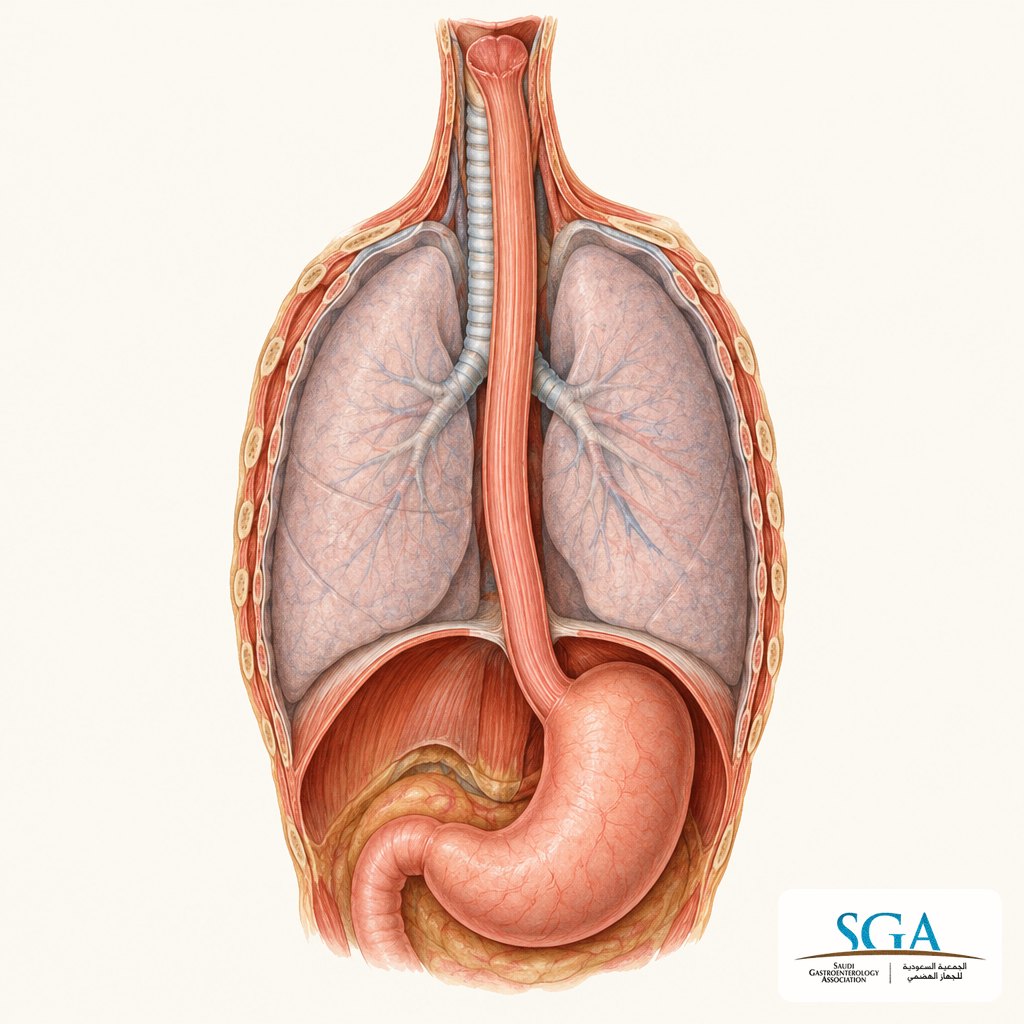
The diaphragm is the muscle that separates the chest from the abdomen. The food pipe (esophagus) passes through a small opening in it, called the hiatus, to join the stomach. In a hiatal hernia, part of the stomach moves up through this opening into the chest. The most common type is a sliding hernia, in which the junction between the esophagus and stomach moves up and down. The less common type is a paraesophageal hernia, in which part of the stomach sits beside the esophagus in the chest. This type matters more because it can become stuck or twisted.
How common is it?
Hiatal hernia is common, especially with increasing age, and many people have one without ever knowing. It is more common in people with excess weight and in pregnancy. Most are small sliding hernias.
Why does it happen?
The opening in the diaphragm can widen and weaken with age, and pressure inside the abdomen pushes the stomach upward. Things that raise abdominal pressure include obesity, pregnancy, chronic coughing, repeated straining or heavy lifting, and constipation. Some people are born with a larger opening, and previous surgery in the area can also contribute.
Symptoms
- Heartburn, a burning feeling behind the breastbone
- Regurgitation, sour or bitter fluid coming up into the mouth
- Belching, bloating and feeling full quickly
- Difficulty swallowing or the feeling that food sticks
- Chest discomfort, especially after meals or lying down
- Chronic cough or hoarse voice from reflux
Red flags — seek urgent medical care
Severe sudden chest or upper abdominal pain, with vomiting or being unable to vomit
The hernia may be trapped or twisted (strangulated). Go to the emergency room now.
Chest pain with sweating, breathlessness, or pain spreading to the arm or jaw
This may be a heart problem rather than reflux. Call emergency services.
Vomiting blood, black stools, or unexplained anemia
Bleeding from the stomach or esophagus. Seek emergency care.
Food or liquids regularly sticking, or painful swallowing
Needs a prompt appointment to check for narrowing or other causes.
Unplanned weight loss with swallowing trouble or persistent vomiting
Needs urgent evaluation to rule out serious causes.
How is it diagnosed?
Many small hernias are found by chance. Upper endoscopy (a thin camera passed through the mouth to look at the esophagus and stomach) shows the hernia and any damage from reflux. A barium swallow (X-ray after drinking a contrast liquid) shows the size and type. Other tests, such as an esophageal manometry (pressure test) and a 24-hour pH test measuring acid, may be done before surgery.
Outlook — what to expect
Most hiatal hernias are harmless and respond well to lifestyle measures and acid-reducing medicine. Surgery is considered for troublesome symptoms not controlled by medicine, for complications, or for paraesophageal hernias with symptoms. Hernias can come back after repair, so follow-up is useful.
Treatment
Habits & Lifestyle
Simple changes lower pressure on the stomach and reduce reflux.
- Aim for a healthy weight; losing extra weight often reduces symptoms.
- Raise the head of the bed (not just extra pillows) and avoid lying down for 2 to 3 hours after meals.
- Avoid tight belts and clothes around the waist.
- Avoid straining and heavy lifting; treat constipation and chronic cough.
- Stop smoking.
Diet
Eating patterns matter more than any single food.
- Eat smaller, more frequent meals and avoid large late dinners.
- Notice and limit your personal triggers, such as fatty or fried foods, very spicy foods, chocolate, coffee, carbonated drinks and citrus.
- Eat slowly and chew well.
- Limit alcohol.
Medications
Medicines treat reflux symptoms; they do not make the hernia go away.
- Antacids give quick, short-lived relief for occasional heartburn.
- Acid-reducing medicines such as H2 blockers or proton pump inhibitors (PPIs) are used for regular symptoms, at the lowest effective dose and duration.
- Take PPIs as directed, usually before a meal; do not continue long-term without review.
- Review medicines that can worsen reflux or irritate the esophagus with your doctor.
Procedures & Surgery
Most people never need surgery.
- Surgery repairs the opening and often wraps the top of the stomach around the esophagus (fundoplication); it is usually done by keyhole.
- It is considered for severe reflux not controlled by medicine, large or paraesophageal hernias with symptoms, or complications.
- Emergency surgery is needed if a hernia becomes trapped or twisted.
- Tests such as pH studies and manometry help choose the right operation.
In the Saudi context
Large evening meals after fasting during Ramadan can worsen reflux. Eating smaller portions at iftar, waiting before lying down, and speaking with your doctor about the timing of medicines can help.
Questions to ask your doctor
Save this list or print it before your appointment — doctors appreciate prepared patients.
- What type of hiatal hernia do I have, and how big is it?
- Do I need to take acid-reducing medicine long-term?
- Do I need an endoscopy or other tests?
- Would surgery help my symptoms, and what are the risks?
- Which symptoms mean I should seek urgent care?
Was this guide helpful?
Status: Approved for publication by SGA; individual clinician review is ongoing · Published 24/04/2026
For general education only; it does not replace your doctor’s advice. Individual clinician review of this guide is ongoing. SGA clinician? Review this guide