

saudigastro.com/patients/gist
Category
Serious
Red flags
5
This article is educational and does not replace your doctor's advice. Seek urgent care for any red-flag symptoms.
What is it?
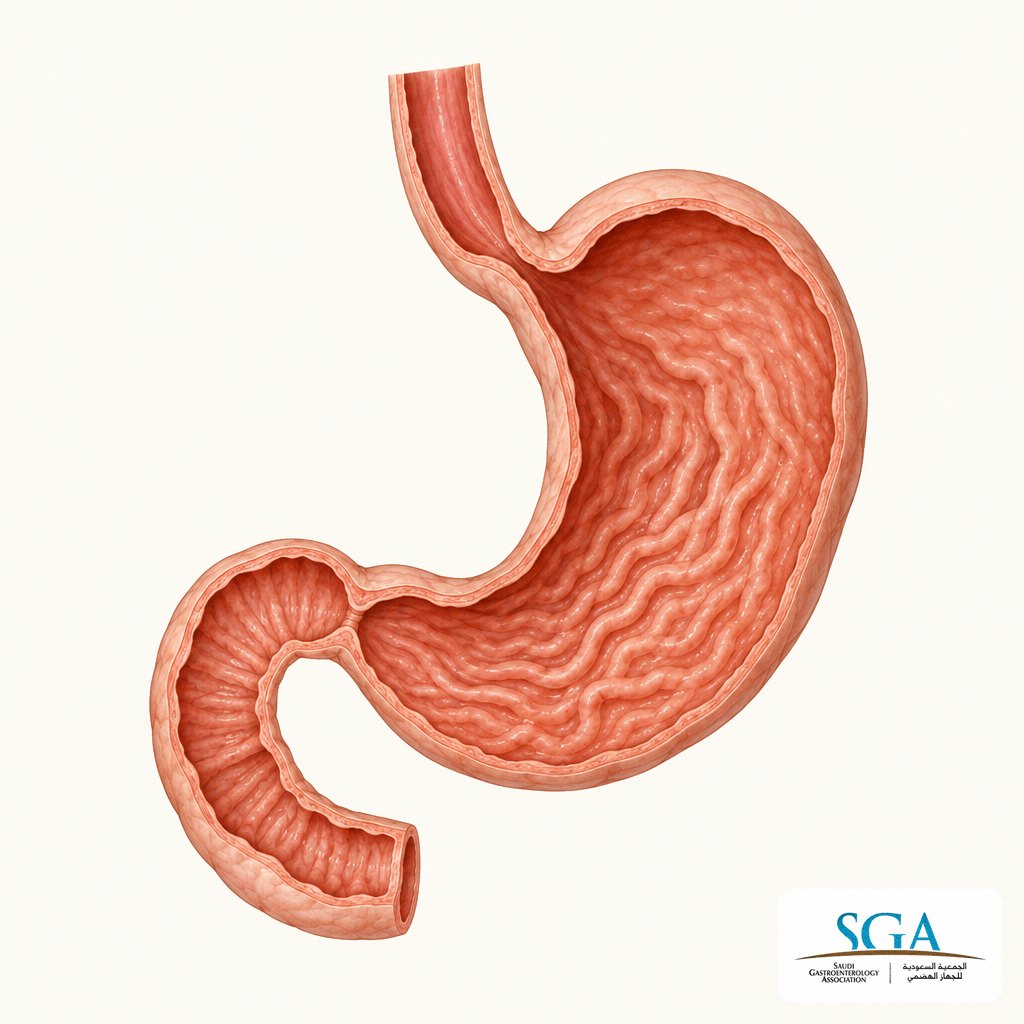
A gastrointestinal stromal tumour (GIST) is a type of sarcoma, a cancer that starts in connective tissue rather than in the lining of the gut. It begins in special cells in the wall of the digestive tract called the interstitial cells of Cajal, which help control gut movement. GISTs can occur anywhere from the esophagus to the rectum but are most often in the stomach and small bowel. Some are small and slow-growing and some behave more aggressively. They are different from the more common gut cancers and are treated differently.
How common is it?
GIST is rare. It is mostly diagnosed in middle-aged and older adults and is uncommon in children. Small ones are often found by chance during a scan or endoscopy for another reason.
Why does it happen?
Most GISTs are caused by a change (mutation) in a gene, commonly KIT or PDGFRA, that makes cells grow without control. This change usually happens by chance during life and is not inherited. Rarely, GIST runs in families or is linked to certain inherited syndromes. There is no known lifestyle cause. Knowing the mutation matters because it helps choose the best medicine.
Symptoms
- No symptoms at all when the tumour is small
- Vague belly pain or discomfort, bloating or feeling full early
- Slow, hidden bleeding leading to tiredness, paleness and anemia (low red blood cells)
- Black stool or vomiting blood if it bleeds more heavily
- A lump felt in the belly in larger tumours
- Nausea, weight loss, or difficulty swallowing depending on the site
Red flags — seek urgent medical care
Vomiting blood or black, tar-like stool
Possible significant bleeding. Go to the emergency department now.
Sudden severe belly pain, fever or a rigid belly
Could mean the tumour has ruptured or bowel is blocked. This is an emergency.
Repeated vomiting and inability to pass gas or stool
May indicate bowel obstruction. Seek emergency care.
Dizziness, fainting or a racing heart
Signs of blood loss. Seek emergency care.
Unexplained weight loss, ongoing tiredness or a growing belly lump
Needs prompt medical evaluation.
How is it diagnosed?
GIST is usually suspected on endoscopy (a camera test) as a smooth bulge under the lining, or on a CT or MRI scan. Endoscopic ultrasound (a camera with an ultrasound probe) can show which layer it comes from and allow a needle biopsy (a small tissue sample). Pathologists examine the tissue for GIST markers such as KIT and count the dividing cells. Genetic testing of the tumour is done in many cases. Staging scans look for spread, most often to the liver or the lining of the belly.
What the latest science says
The discovery of tumour gene changes led to targeted tablets (called tyrosine kinase inhibitors) that block the signals driving the tumour, which has changed outcomes for many people. Different genetic types respond differently, and newer medicines are available for tumours that stop responding. Care in a centre experienced with sarcomas is recommended.
Outlook — what to expect
The outlook varies widely and depends on the tumour size, where it is, how fast its cells divide, whether it has spread and whether it can be removed completely. Many small, low-risk tumours are cured by surgery, and targeted tablets can control larger or spread tumours for long periods. Long follow-up is needed because GIST can return. Your team can explain the risk level of your own tumour.
Treatment
Habits & Lifestyle
A GIST diagnosis is worrying, but you can play an active part in your care.
- Ask for your care to be reviewed by a multidisciplinary team including a surgeon and an oncologist.
- Keep every follow-up scan and clinic appointment.
- Take tablets exactly as prescribed and report side effects early instead of stopping on your own.
- Stay as active as you can; gentle exercise helps energy and mood.
- Seek emotional support from family, friends or a counsellor.
Diet
No diet treats GIST, but good nutrition helps you cope with surgery and treatment.
- Eat balanced meals with enough protein to keep strength and weight.
- Small frequent meals can help if you feel full quickly or have nausea.
- Some tablets can interact with grapefruit, pomelo and some herbal products; ask your pharmacist before consuming them.
- Ask a dietitian for help if you lose weight or after a stomach operation.
Medications
Targeted tablets are a key treatment for many people with GIST. Your oncologist selects the medicine based on your tumour's genetic profile and monitors you closely.
- Imatinib is the standard first targeted tablet for many GISTs; other medicines are used if the tumour stops responding or has a different genetic type.
- These medicines may be given before surgery to shrink a large tumour, or after surgery to lower the chance of return, depending on risk.
- Common side effects include tiredness, swelling around the eyes or legs, nausea, diarrhea and skin changes; your team can help manage them.
- Check with your doctor before starting any other medicine, supplement or herbal product.
Procedures & Surgery
Surgery is the main curative treatment when the tumour can be removed completely.
- Surgery removes the tumour with a margin of healthy tissue, often keeping as much of the organ as possible.
- Many operations are done by keyhole (laparoscopic) surgery when suitable.
- Some very small tumours are watched with regular endoscopy or scans, if your team considers this safe.
- Tumours that have spread may be treated mainly with tablets, and sometimes with other local treatments for the liver.
Living with the condition
- Follow-up usually involves regular scans for several years, so keep your records together.
- Tell your family doctor and pharmacist that you take targeted therapy.
- Ask about genetic counselling if your doctors suspect an inherited form.
Questions to ask your doctor
Save this list or print it before your appointment — doctors appreciate prepared patients.
- How big and how risky is my tumour?
- Has my tumour had genetic testing, and what does it mean?
- Do I need surgery, tablets, or both, and for how long?
- What side effects should I watch for?
- How often will I need scans and follow-up?
Was this guide helpful?
Status: Approved for publication by SGA; individual clinician review is ongoing · Published 24/04/2026
For general education only; it does not replace your doctor’s advice. Individual clinician review of this guide is ongoing. SGA clinician? Review this guide