

saudigastro.com/patients/food-impaction
Category
Serious
Red flags
5
This article is educational and does not replace your doctor's advice. Seek urgent care for any red-flag symptoms.
What is it?
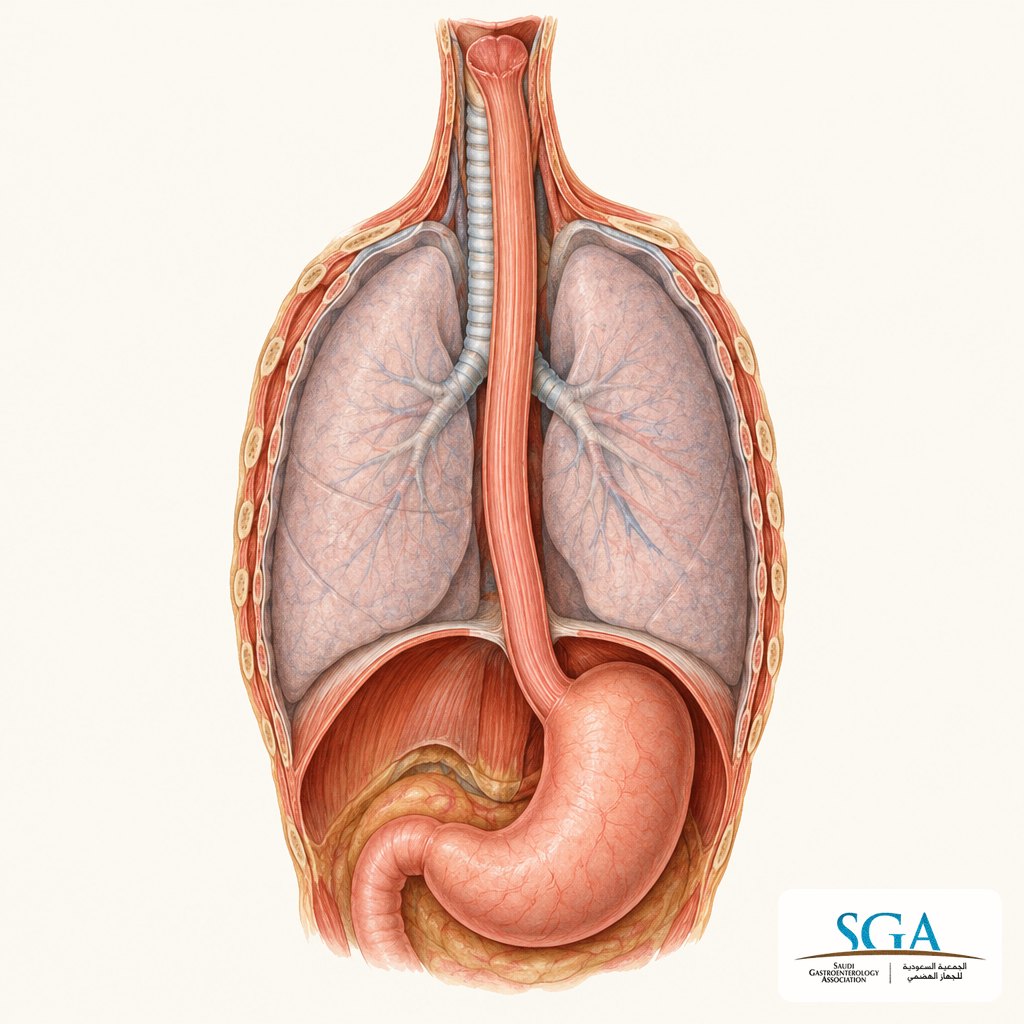
Go to the emergency department or call emergency services now if food is stuck and you cannot swallow saliva, are drooling, have chest pain, or have any difficulty breathing. Do not wait for it to pass. Food impaction means a piece of food (often meat) has lodged in the esophagus (the food pipe) and does not move down into the stomach. It is a medical emergency because the food can block the pipe completely and, over time, can damage the wall.
How common is it?
It is a common reason for urgent endoscopy. It can happen at any age, but is seen more often in people who already have a narrowing or an inflammatory condition of the esophagus. Children can also be affected, and in children the cause is often different.
Why does it happen?
Food usually sticks because the esophagus is narrowed or does not squeeze well. Common underlying causes include eosinophilic esophagitis (an allergic-type inflammation of the esophagus), a stricture (a scarred narrowing, often from long-standing acid reflux), a ring or web of tissue, and motility problems (when the muscles do not push food down properly). Eating quickly, poor chewing, ill-fitting dentures and large pieces of meat make it more likely. In children, swallowing small objects or toys is also a cause.
Symptoms
- A sudden feeling that food has stopped in the chest or throat
- Inability to swallow food, liquids or even saliva
- Drooling or spitting up saliva
- Chest pain or pressure behind the breastbone
- Retching or vomiting, with relief only if the food comes back up
- Coughing or gagging
Red flags — seek urgent medical care
Difficulty breathing, noisy breathing, or turning blue
The airway may be affected. Call emergency services immediately.
Unable to swallow saliva or drooling
The esophagus is probably fully blocked. Go to the emergency department now.
Severe chest pain, fever, or pain on swallowing after vomiting or forceful retching
Could mean a tear in the esophagus, which is an emergency.
Food stuck for more than a short time, even if you feel otherwise well
Do not wait. Seek emergency care, because treatment is best done early.
A child who may have swallowed an object, or who is drooling or refusing to swallow
A child needs to be seen at the emergency department immediately.
How is it diagnosed?
The history is usually clear. In hospital, the team checks your breathing and may take an X-ray if an object or a tear is suspected. The treatment and the diagnosis are often done together by endoscopy, a thin camera passed through the mouth under sedation. Once the food is removed, the doctor looks for the cause and often takes small tissue samples (biopsies) from the esophagus. Further tests may follow to check for reflux damage, eosinophilic esophagitis or a motility problem.
Outlook — what to expect
Most food impactions are removed safely at endoscopy. The most important step afterwards is to find and treat the reason, because without treatment it can happen again. Complications such as a tear are uncommon when treatment is not delayed.
Treatment
Habits & Lifestyle
There is no home treatment for food that is stuck. Do not try to force it down, induce vomiting, or wait it out. Go to the emergency department.
- Do not eat or drink while waiting for care
- Do not take fizzy drinks, meat tenderiser or home remedies
- Stay sitting upright and spit out saliva into a bowl if needed
- After recovery, eat slowly, take small bites and chew well
Diet
Once the food has been removed and your doctor agrees, careful eating helps prevent a repeat.
- Cut meat and other firm foods into small pieces
- Drink fluids between bites
- Avoid eating while rushing, talking or lying down
- If you have eosinophilic esophagitis, follow the diet plan from your specialist
Medications
Medicines may be used after the emergency to treat the cause, as your doctor decides.
- Acid-reducing medicines if reflux is the cause
- Anti-inflammatory treatment for eosinophilic esophagitis
- Do not use any medicine to try to dissolve the food at home
Procedures & Surgery
Removal of stuck food is done by a specialist in hospital.
- Endoscopy to remove the food under sedation, with the airway protected
- Biopsies taken from the esophagus to find the cause
- Stretching (dilation) of a narrowed area, sometimes at a later visit
- Follow-up endoscopy to check healing and treat the cause
Questions to ask your doctor
Save this list or print it before your appointment — doctors appreciate prepared patients.
- What caused the food to get stuck?
- Do I need biopsies or more tests?
- Do I need a stretching procedure?
- Which foods should I avoid for now?
- What should I do if it happens again?
Was this guide helpful?
Status: Approved for publication by SGA; individual clinician review is ongoing · Published 24/04/2026
For general education only; it does not replace your doctor’s advice. Individual clinician review of this guide is ongoing. SGA clinician? Review this guide