

saudigastro.com/patients/esophageal-ph-impedance
Results
The recording is analysed by the team after you return the equipment. Results are usually ready within days to a couple of weeks, and your doctor will explain whether reflux is present, how it relates to your symptoms, and what treatment or further tests are advised.
This article is educational and does not replace your doctor's advice. Seek urgent care for any red-flag symptoms.
What is it?
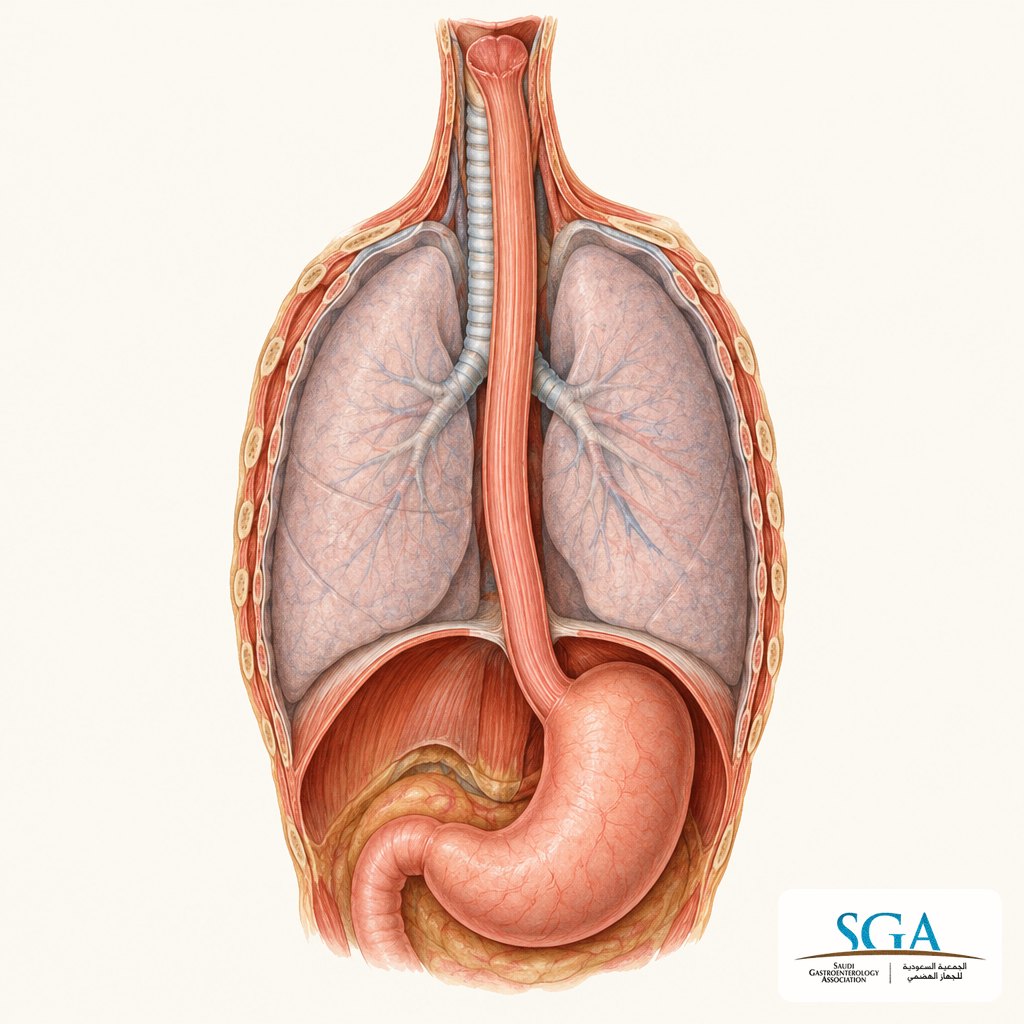
In gastro-oesophageal reflux, stomach contents flow back up into the food pipe (oesophagus). A 24-hour pH and impedance study measures this directly. A very thin, soft tube with sensors is passed through your nose and down into the food pipe, with the other end connected to a small recorder you wear on a strap. The pH sensor measures how acidic the liquid is (the pH is a scale for acidity), and the impedance sensors detect any liquid or gas moving back up, whether it is acid, weakly acid or non-acid. Alternatively, a tiny capsule can be attached to the lining of the food pipe during an endoscopy, which records acid for 48 to 96 hours and sends the data to a receiver without a tube in the nose. You go about your normal day while the device records, and you note your meals, lying down and symptoms.
Why is it done?
It helps show whether reflux is truly the cause of symptoms such as heartburn, regurgitation, chest pain, chronic cough or a feeling of a lump in the throat, especially when the symptoms continue despite acid-reducing medicines or when the diagnosis is uncertain. It also measures how much reflux there is, whether symptoms line up with reflux events, and whether the reflux is acid or non-acid. This guides treatment, and it is often done before anti-reflux surgery or other procedures to confirm the diagnosis. It is done either while off acid-reducing medicines (to see if reflux is present) or while on them (to see why symptoms persist).
Who needs it?
- People with typical reflux symptoms that have not improved with acid-reducing medicines
- People with symptoms that may or may not be reflux, such as chronic cough, hoarseness, throat clearing or chest pain after heart causes were excluded
- People being considered for anti-reflux surgery or other reflux procedures
- People with ongoing regurgitation or belching where the doctor wants to see what is coming back up
Before the procedure
- Your centre will tell you if you should stop acid-reducing medicines before the test, and for how long. Do not stop or change them unless instructed, because the plan depends on the question being asked.
- Stopping medicines such as proton-pump inhibitors, H2 blockers and antacids is sometimes needed for several days to a week or more. Ask what you can take for relief in the meantime.
- You will usually be asked to fast for several hours before the tube is placed; the centre will give exact times. Tell the team about nose problems, bleeding problems, blood thinners, allergies and anything that would make passing a tube difficult.
- Wear loose, comfortable clothing with a top that buttons, and plan for a normal day without a shower or swimming while the recorder is attached.
- No sedation is usually given for the tube test, so you can usually go home and drive afterwards. If you are fasting in Ramadan, tell the team so the timing of the test and your meals can be planned.
During the procedure
A nurse or technician numbs your nose with gel or spray. You sip water while the thin tube is passed through your nose into the food pipe; this can be uncomfortable, may make you cough, gag or have watery eyes, but it takes only a few minutes. The tube is taped to your nose and cheek and connected to the recorder. You then go about your usual day and eat normal meals unless told otherwise, keeping a diary or pressing buttons on the recorder when you eat, lie down, and have symptoms such as heartburn, cough or chest pain. After about 24 hours you return, and the tube is gently pulled out, which takes seconds. If the capsule method is used, it is attached during a short endoscopy under sedation, and it falls off and passes in the stool after several days.
After the procedure
You can usually return to normal activities, eat, and drive straight away. A sore nose or throat, a mild nosebleed or a slightly hoarse voice for a short time is common. Restart your medicines when the team tells you. If the capsule method was used, you may feel chest discomfort or pain when swallowing for a few days; avoid MRI scans until you are told the capsule has passed, and seek help if swallowing becomes painful or difficult. The doctor will analyse the recording and your diary together, which takes some time.
Risks
- Nose or throat discomfort, a sore throat, gagging while the tube is passed, or a mild nosebleed (common, short-lived)
- Some people find the tube unpleasant during the day and eating less comfortable; it is possible to feel self-conscious about it.
- Rarely, the tube cannot be passed, or it moves or comes out, in which case the test may need to be repeated
- Capsule method: chest pain, difficulty swallowing, or the capsule detaching early or late; rarely a small bleed or a need to remove it
- The study reflects one or a few days only, which may not be typical, and the results must be read with your symptoms and other tests.
- Contact your doctor if you have heavy or persistent nosebleeding, chest pain, trouble swallowing or breathing, or if the tube comes out.
When you get results
Alternatives if you decline
Alternatives include a trial of acid-reducing medicine, a gastroscopy to look for damage from reflux, a barium swallow X-ray, and oesophageal manometry (a pressure test of the food pipe). A medicine trial is often tried first. These tests answer different questions: gastroscopy shows damage but cannot measure reflux over a day, and a normal gastroscopy does not rule out reflux. The pH-impedance study is the most direct test of whether reflux is happening. If you decline it, treatment may be based on symptoms alone, which can lead to unneeded treatment or delay in finding another cause.
Questions to ask your doctor
Save this list or print it before your appointment — doctors appreciate prepared patients.
- Should I stop my reflux medicines before the test, and for how long?
- What can I take for heartburn while I am off my medicines?
- Will I have the tube in my nose or the capsule method, and which is better for me?
- Can I go to work or school and eat normally with the tube in?
- How will the results change my treatment?
Was this guide helpful?
Status: Approved for publication by SGA; individual clinician review is ongoing · Published 24/04/2026
For general education only; it does not replace your doctor’s advice. Individual clinician review of this guide is ongoing. SGA clinician? Review this guide