

saudigastro.com/patients/esophageal-cancer-screening
Category
Screening
Red flags
4
This article is educational and does not replace your doctor's advice. Seek urgent care for any red-flag symptoms.
What is it?
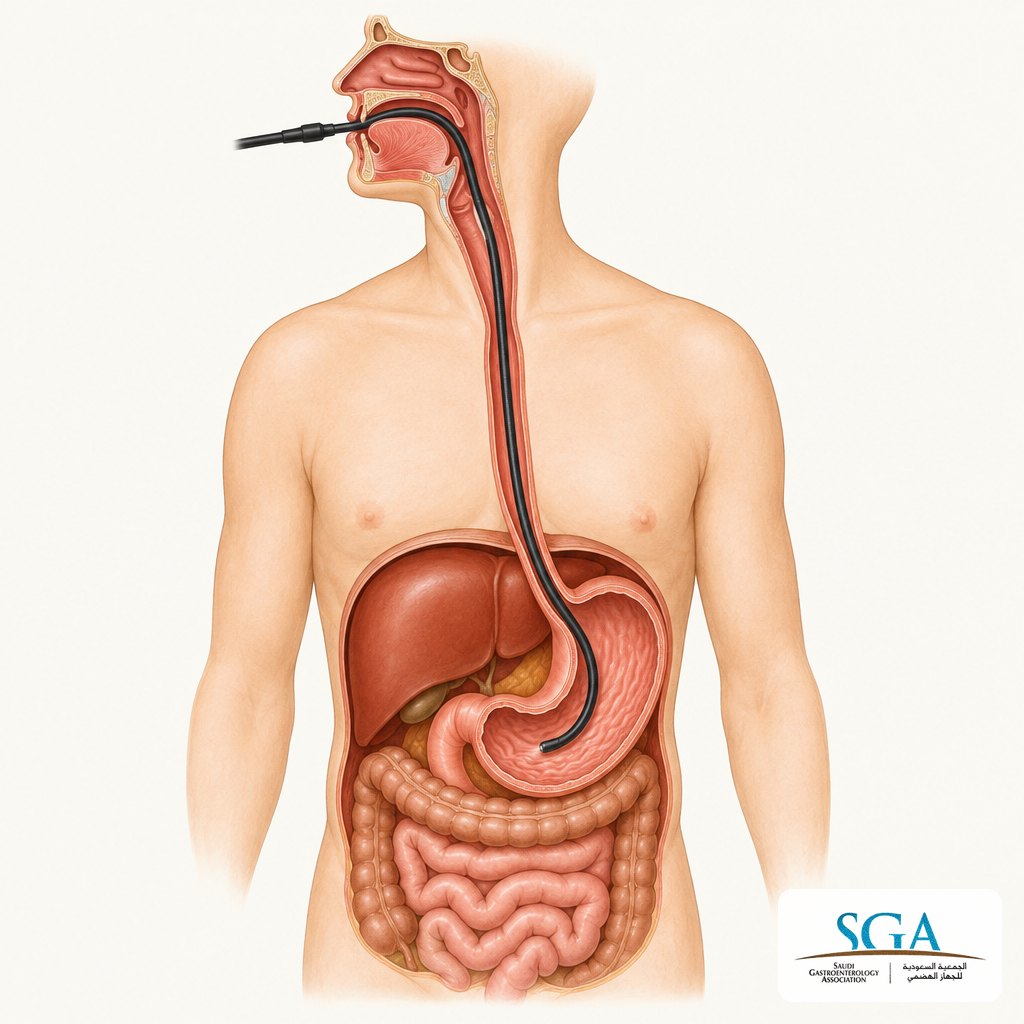
The esophagus is the muscular tube that carries food from the mouth to the stomach. Screening means checking people who feel well but who have risk factors, so that early changes can be found and treated before they become cancer. The main screening tool is upper endoscopy (also called gastroscopy), where a thin flexible tube with a camera is passed through the mouth to look at the lining. A key target is Barrett esophagus, a change in the lining of the lower esophagus caused by long-standing acid reflux, which can slowly raise the risk of cancer in a small number of people.
How common is it?
Esophageal cancer is less common than many other cancers, and most people with acid reflux never develop it. Because the condition is uncommon, routine screening of everyone is not advised; it is offered only to groups with higher risk.
Why does it happen?
There are two main types. Adenocarcinoma is linked to long-standing reflux, Barrett esophagus, excess body weight and smoking. Squamous cell carcinoma is linked to smoking, alcohol, very hot drinks over many years, and in some regions to other exposures and to diet. Having a risk factor does not mean you will get cancer; it means your doctor may think about checking you.
Symptoms
- Screening is for people with no cancer symptoms, so there may be none
- Long-standing heartburn or acid reflux (burning behind the breastbone) that comes back often
- Regurgitation of food or sour liquid into the throat or mouth
- Needing regular antacid or acid-lowering medicines for years
- Chronic cough, hoarseness or throat clearing that may be reflux-related
Red flags — seek urgent medical care
Difficulty swallowing, or food sticking in the chest
This is an alarm symptom, not a screening situation. See a doctor promptly for an endoscopy; do not wait for a routine check.
Unplanned weight loss
Can be a sign of a serious problem in the digestive tract. Arrange to see a doctor soon.
Vomiting blood, or black tarry stools
May mean bleeding from the upper digestive tract. Go to the emergency department now.
Pain on swallowing, or persistent chest or upper belly pain
Needs medical assessment. If the pain is severe or comes with breathlessness or sweating, call emergency services.
How is it diagnosed?
Screening is done with upper endoscopy. The doctor looks at the lining and takes small samples (biopsies) from any area that looks abnormal. These are examined under a microscope to see whether Barrett esophagus or abnormal cells are present. Some centres are studying less invasive tests, such as a swallowed sponge-on-a-string device, but upper endoscopy remains the standard. Your doctor decides if and when you should be tested, based on your age, how long you have had reflux, your smoking history, family history and other factors.
What the latest science says
Guidelines generally suggest considering screening for people with long-standing reflux who also have several risk factors, such as being male, older, a smoker, overweight, or having a close relative with Barrett esophagus or esophageal cancer. Routine screening of the general population is not recommended. Research on simpler, less invasive screening tests is ongoing.
Outlook — what to expect
If Barrett esophagus is found, most people never develop cancer, and regular surveillance endoscopy lets the team catch changes early, when they can often be treated through the scope. If screening finds nothing, you can usually continue with reflux care and be re-assessed only if your symptoms or risks change.
Treatment
Habits & Lifestyle
Lifestyle changes lower reflux and reduce several risk factors.
- Stop smoking and avoid all tobacco products
- Avoid alcohol
- Work towards a healthy weight, especially around the waist
- Avoid lying down within about three hours after eating, and raise the head of the bed if you have night-time reflux
- Let very hot drinks cool before drinking them
Diet
There is no diet that prevents esophageal cancer for certain, but eating well supports overall digestive health.
- Eat plenty of fruit, vegetables and whole grains
- Choose smaller meals rather than very large ones
- Notice personal reflux triggers (for example very fatty or spicy meals) and limit them if they bother you
- Limit processed and heavily salted foods
Medications
Medicines control reflux; they do not replace screening. Your doctor decides what is right for you.
- Acid-lowering medicines such as proton pump inhibitors may be prescribed for reflux or Barrett esophagus
- Antacids can give short-term relief of heartburn
- Do not stay on acid-lowering medicines indefinitely without review; ask your doctor about the right duration
- Do not use medicines as a reason to skip a recommended endoscopy
Procedures & Surgery
Procedures are used for screening and, if needed, treatment of early changes.
- Upper endoscopy with biopsies is the standard screening test
- If Barrett esophagus is found, repeat endoscopy at intervals set by your doctor
- Early abnormal changes can often be treated through the scope (for example ablation or removal of the affected lining)
- Anti-reflux surgery is sometimes considered for severe reflux, but it does not remove the need for follow-up if Barrett esophagus is present
Living with the condition
- Keep your follow-up endoscopy appointments even if you feel well.
- Report any new swallowing difficulty, weight loss or bleeding promptly rather than waiting for the next scheduled test.
Questions to ask your doctor
Save this list or print it before your appointment — doctors appreciate prepared patients.
- Am I in a group that should be screened for esophageal cancer?
- How often will I need repeat endoscopy if Barrett esophagus is found?
- Should I stay on my acid-lowering medicine, and for how long?
- Which symptoms should make me come back sooner?
- Does my family history change my risk?
Was this guide helpful?
Status: Approved for publication by SGA; individual clinician review is ongoing · Published 24/04/2026
For general education only; it does not replace your doctor’s advice. Individual clinician review of this guide is ongoing. SGA clinician? Review this guide