

saudigastro.com/patients/esophageal-cancer
Category
Serious
Red flags
5
This article is educational and does not replace your doctor's advice. Seek urgent care for any red-flag symptoms.
What is it?
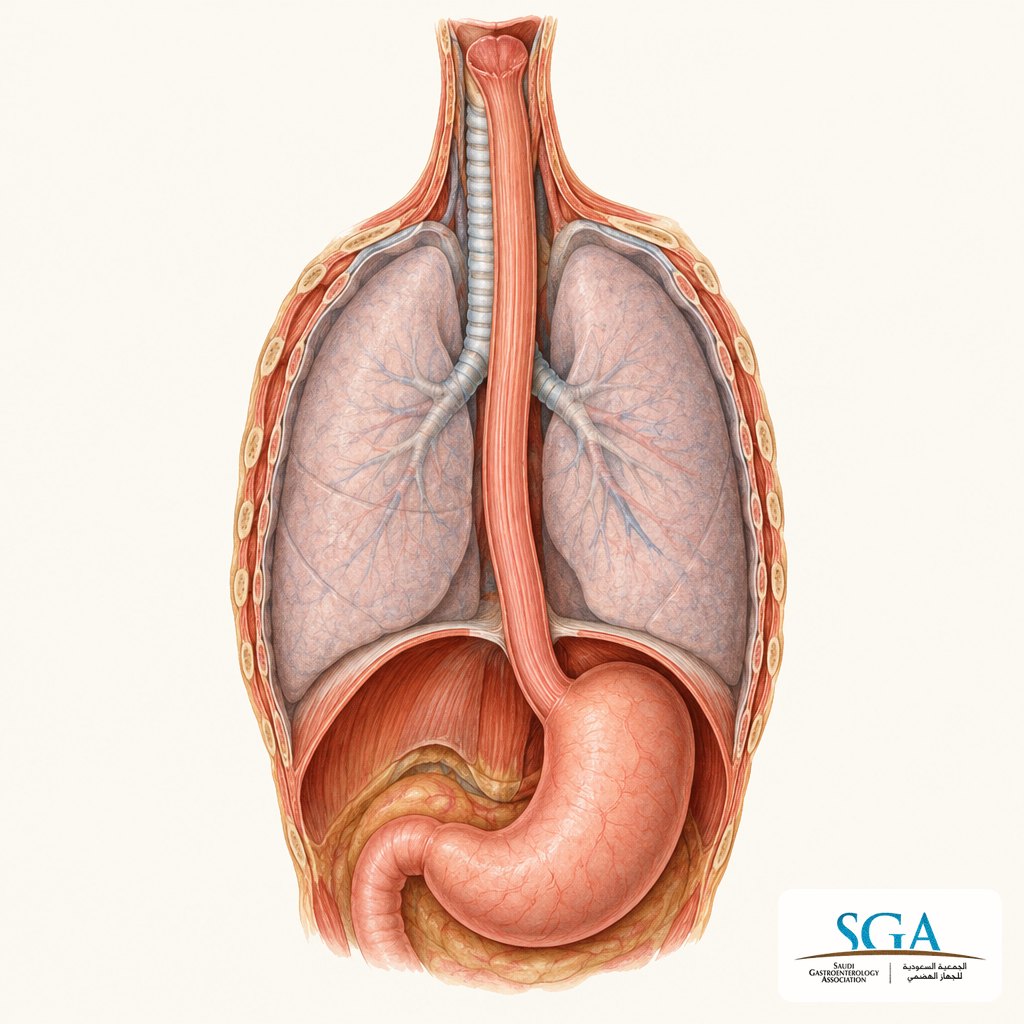
The esophagus is the muscular tube that carries food from the throat to the stomach. Cancer of the esophagus begins in the cells lining it. The two main types are squamous cell carcinoma, which arises from the flat cells lining most of the tube, and adenocarcinoma, which arises from glandular cells, usually near the lower end, often in an area changed by long-standing acid reflux (Barrett's esophagus, where the lining changes to a type similar to the intestine).
How common is it?
Esophageal cancer is much less common than reflux, but it is a serious cancer. It is seen more often in older adults and in men. The proportion of each type varies from one population to another.
Why does it happen?
Risk factors for squamous cell cancer include smoking, alcohol, very hot drinks, and a poor diet low in fruit and vegetables. For adenocarcinoma they include long-standing reflux, Barrett's esophagus, obesity and smoking. Most people with reflux never develop cancer. A family history, previous radiation to the chest, and swallowing caustic substances can also increase the risk.
Symptoms
- Difficulty swallowing (dysphagia), first with solid foods like bread and meat, later with soft food and liquids
- Pain or discomfort when swallowing, or a feeling of food sticking
- Unintentional weight loss and loss of appetite
- Chest or upper back pain, or persistent heartburn that is new or worsening
- Hoarse voice, ongoing cough, or vomiting of food
- Tiredness from anemia, or black stools from slow bleeding
Red flags — seek urgent medical care
New or worsening difficulty swallowing, especially if it lasts more than a couple of weeks
Needs a prompt assessment with an endoscopy, usually an urgent referral. Do not wait for it to pass.
Unplanned weight loss with swallowing trouble
Needs an urgent evaluation.
Vomiting blood or passing black, tarry stool
Bleeding. Go to the emergency room now.
Food completely stuck, unable to swallow saliva, or drooling
The esophagus may be blocked. Go to the emergency room.
Choking, coughing with eating or drinking, or repeated chest infections
Food or liquid may be entering the airway. See a doctor urgently.
How is it diagnosed?
The main test is upper endoscopy: a thin flexible camera passed through the mouth, with small tissue samples (biopsies) taken from any abnormal area. To see how far the cancer has spread (staging), doctors use CT scans, a PET-CT scan, and endoscopic ultrasound (an ultrasound probe on the end of an endoscope that shows the layers of the wall and nearby lymph nodes). Sometimes a laparoscopy (keyhole look inside the abdomen) is used. A multidisciplinary team then recommends treatment.
What the latest science says
Treatment has advanced: for many patients, chemotherapy with or without radiotherapy before surgery, and for some, immunotherapy, improve outcomes. Early cancers can sometimes be removed through the endoscope. People with Barrett's esophagus are offered periodic endoscopy surveillance. Plans are individual, so ask your team what applies to you.
Outlook — what to expect
The outlook depends mainly on the stage at diagnosis. Cancers found early can often be treated with the aim of cure, whereas advanced cancer is usually treated to control the disease, ease symptoms and maintain quality of life. Every person is different, and your cancer team can discuss what to expect in your situation. Supportive care and nutrition are an important part of treatment at all stages.
Treatment
Habits & Lifestyle
Healthy habits support treatment and reduce risk. They are not a replacement for specialist care.
- Stop smoking and avoid alcohol; support to quit is available.
- Do not delay a swallowing problem; get it checked.
- Treat long-standing reflux and keep regular follow-up if you have Barrett's esophagus.
- Aim for a healthy weight and stay as active as you can during treatment.
- Ask about psychological and social support for you and your family.
Diet
Eating enough is hard when swallowing hurts, and a dietitian is an important part of your team.
- Eat small, frequent meals of soft, moist foods; blended or pureed foods may be easier.
- Eat slowly, chew well and sit upright during and after meals.
- Use high-calorie, high-protein foods and nutritional supplement drinks as advised.
- A feeding tube may be needed temporarily if you cannot eat enough; your team will explain.
- Avoid very hot drinks and alcohol.
Medications
Cancer medicines are given by an oncology team, tailored to the type and stage.
- Chemotherapy, often with radiotherapy, may be given before surgery or as the main treatment.
- Immunotherapy or targeted medicines are used in selected patients depending on tumour tests.
- Pain relief, anti-sickness medicines and acid-reducing medicines are given to ease symptoms.
- Report side effects early, such as fever during chemotherapy, as they can be managed.
Procedures & Surgery
Procedures can treat the cancer or relieve swallowing problems.
- Very early cancers may be removed through the endoscope (endoscopic resection).
- Surgery to remove part of the esophagus (esophagectomy) is a major operation, done in specialist centres.
- A stent (an expandable tube) or other methods can reopen a blocked esophagus to improve swallowing in advanced disease.
- Feeding tubes can help maintain nutrition.
- Dilation may be used for narrowing in selected cases.
Living with the condition
- Ask for a named nurse or navigator to coordinate appointments.
- Palliative and supportive care teams help with symptoms at any stage, not only at the end of life.
- Talk openly with your family and care team about your wishes and worries.
In the Saudi context
If you are being treated for cancer, speak with your doctor about fasting during Ramadan, as it may not be safe for you. Family involvement in decisions is common and welcome; your team can arrange support for families.
Questions to ask your doctor
Save this list or print it before your appointment — doctors appreciate prepared patients.
- What type and stage of esophageal cancer do I have?
- What are the goals of treatment: cure or control?
- What are the benefits and risks of each treatment option?
- How will treatment affect my eating, and can I see a dietitian?
- Is genetic or tumour testing needed, and should my family be screened?
- Who do I contact if I develop new symptoms?
Was this guide helpful?
Status: Approved for publication by SGA; individual clinician review is ongoing · Published 24/04/2026
For general education only; it does not replace your doctor’s advice. Individual clinician review of this guide is ongoing. SGA clinician? Review this guide