

saudigastro.com/patients/colon-polyps
Category
Common
Red flags
4
This article is educational and does not replace your doctor's advice. Seek urgent care for any red-flag symptoms.
What is it?
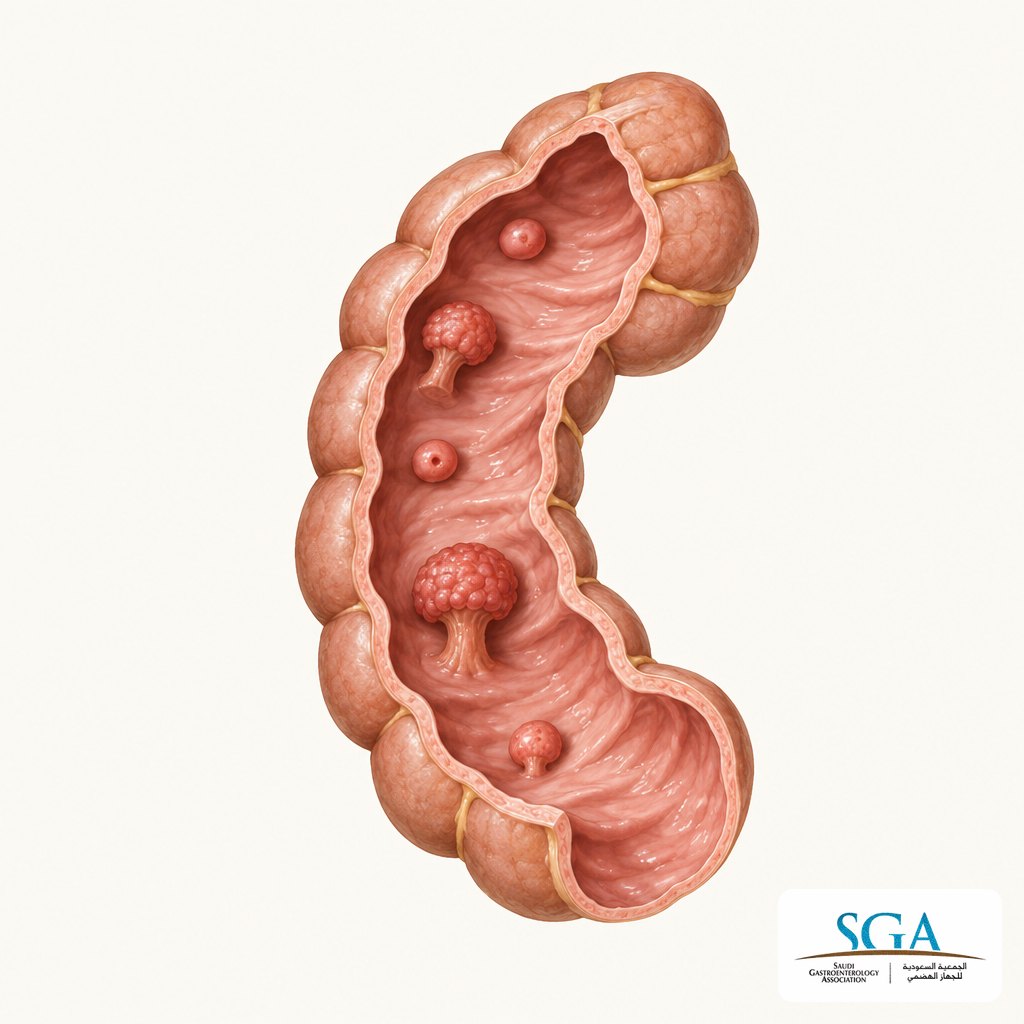
A polyp is a small growth that sticks out from the lining of the colon. Polyps may be flat, raised, or on a stalk. Most are not cancer, but the type matters. Adenomatous polyps (adenomas) are the most common type that can turn into cancer over years. Serrated polyps (sessile serrated lesions) are another type with cancer potential, often flat and easy to miss. Hyperplastic polyps, especially small ones in the lower bowel, are usually harmless. Large polyps, many polyps, and polyps with certain cell patterns carry higher risk.
How common is it?
Colon polyps are very common in adults, and their frequency rises with age. Many people have one or more without ever knowing. They are found mostly during screening colonoscopy or while investigating other symptoms.
Why does it happen?
Polyps form when cells in the bowel lining grow more than they should, because of changes in their genes that build up over time. Risk factors include increasing age, a family history of polyps or colorectal cancer, a diet high in red or processed meat and low in fibre, obesity, smoking, heavy alcohol use, little physical activity, type 2 diabetes and long-standing inflammatory bowel disease. Rarely, people inherit conditions such as familial adenomatous polyposis (FAP) or Lynch syndrome that cause many polyps or early cancers. Most polyps take years to become cancer, which gives time to find and remove them.
Symptoms
- Usually no symptoms at all
- Blood on the toilet paper or in the stool (red or dark)
- A change in bowel habit lasting more than a few weeks
- Iron-deficiency anaemia found on blood tests
- Tiredness or paleness from slow, hidden bleeding
- Mucus in the stool or a feeling of incomplete emptying (with larger polyps)
- Rarely, belly cramps or blockage from a very large polyp
Red flags — seek urgent medical care
Rectal bleeding, especially if repeated or with dark blood
Needs checking; do not assume piles. Colonoscopy may be needed.
Persistent change in bowel habit, or unexplained weight loss
May signal cancer or a large polyp. See a doctor soon.
Anaemia (low blood count) without a clear cause
Hidden bowel bleeding is possible and needs investigation.
After polyp removal: heavy bleeding, severe or worsening belly pain, a swollen hard belly, or fever
Possible bleeding or a tear (perforation) in the bowel wall, which can occur up to two weeks later. Go to the emergency department.
How is it diagnosed?
Colonoscopy is the best test because it both finds and removes polyps in the same session. A thin flexible tube with a camera is passed through the back passage, usually under sedation. Other tests include stool tests (FIT, which detects hidden blood) and CT colonography (a CT scan of the colon). If these are abnormal, a colonoscopy is still needed to remove or sample polyps. Removed polyps are sent to the laboratory, and the pathology report tells your doctor the type, the size, and whether there are any abnormal cells, which determines your follow-up.
Outlook — what to expect
The outlook is excellent. Removing polyps lowers the chance of developing colorectal cancer. However, people who have had polyps are more likely to form new ones, so follow-up colonoscopy is needed. How soon depends on the number, size and type of polyps found and how well the bowel was cleaned; the interval is commonly between about 3 and 10 years, and your doctor will set it for you. Do not shorten or skip it.
Treatment
Habits & Lifestyle
You cannot feel polyps, so prevention relies on screening and healthy habits.
- Take part in screening. It is recommended from the age set in the Saudi national and SGA guidance (for average-risk adults commonly 45 to 50), and earlier if close relatives had polyps or colorectal cancer. Ask your doctor what is right for you.
- Do not smoke, limit alcohol, keep a healthy weight and be physically active.
- Keep your follow-up colonoscopy appointment as advised. Keep a copy of your colonoscopy and pathology reports.
- Tell your relatives if you have had polyps, especially large or advanced ones, as they may need earlier screening.
Diet
Diet cannot remove polyps, but healthy eating is linked with lower risk of new ones.
- Eat more fibre: vegetables, fruit, legumes and whole grains.
- Limit red meat and avoid processed meats; limit sugary drinks and ultra-processed foods.
- Before a colonoscopy, follow the diet instructions you are given (usually low-fibre food a day or more before, then clear fluids). A clean bowel is essential.
Medications
There is no medicine routinely used to treat polyps. Removal is the treatment.
- Bowel preparation medicines (strong laxatives taken the day before) are the most important medicines. Follow the exact instructions, finish the full prep, and tell the unit if you cannot. Poor preparation can hide polyps and means the test may need repeating.
- Ask your doctor in advance what to do with blood thinners (such as warfarin, apixaban, rivaroxaban, clopidogrel), aspirin, and diabetes medicines (including insulin and GLP-1 type injections) before the procedure. Do not stop any of them on your own.
- Iron treatment may be needed if polyps have caused anaemia.
- In selected people with inherited polyposis, your specialist will discuss other options.
Procedures & Surgery
Removal during colonoscopy (polypectomy) is the standard treatment and is usually done on the day, without an incision.
- Polypectomy: small polyps are removed with forceps or a wire loop (snare), sometimes with electric current to seal the base. You do not feel it, and it is usually painless.
- Endoscopic mucosal resection (EMR) or endoscopic submucosal dissection (ESD) are advanced techniques for large or flat polyps. Referral to an expert centre may be advised.
- Risks are uncommon: bleeding (during or up to about two weeks later) and a tear in the bowel wall (perforation). Most bleeding stops by itself or can be treated at colonoscopy, and a perforation may require clips or surgery. Large polyps carry higher risk.
- Surgery is rarely needed: for polyps that cannot be removed endoscopically or that contain cancer with higher-risk features.
- Surveillance colonoscopy is repeated at intervals your doctor sets based on the number, size and type of polyps found, commonly between 3 and 10 years.
Living with the condition
- Being told you had polyps can be worrying. Most are not cancer, and removing them is exactly what prevents cancer.
- Put your next colonoscopy date in your calendar and ask your doctor or hospital to send a reminder.
- If you have several relatives with polyps or bowel cancer at a young age, ask about genetic counselling.
In the Saudi context
Colonoscopy is widely available in Saudi hospitals and endoscopy centres. The national Saudi colorectal cancer screening guidance (2026) is available on the SGA platform. Because colorectal cancer is being seen at younger ages, do not delay screening or a check-up if you have bleeding or a family history.
Questions to ask your doctor
Save this list or print it before your appointment — doctors appreciate prepared patients.
- What type of polyps did I have, and what size?
- Were they all removed, and was the bowel clean enough?
- When should my next colonoscopy be?
- Should my family members be screened earlier?
- What should I do about my blood thinners or diabetes medicines before the next procedure?
Trusted resources
Was this guide helpful?
Status: Approved for publication by SGA; individual clinician review is ongoing · Published 24/04/2026
For general education only; it does not replace your doctor’s advice. Individual clinician review of this guide is ongoing. SGA clinician? Review this guide