

saudigastro.com/patients/caustic-ingestion
Category
Serious
Red flags
5
This article is educational and does not replace your doctor's advice. Seek urgent care for any red-flag symptoms.
What is it?
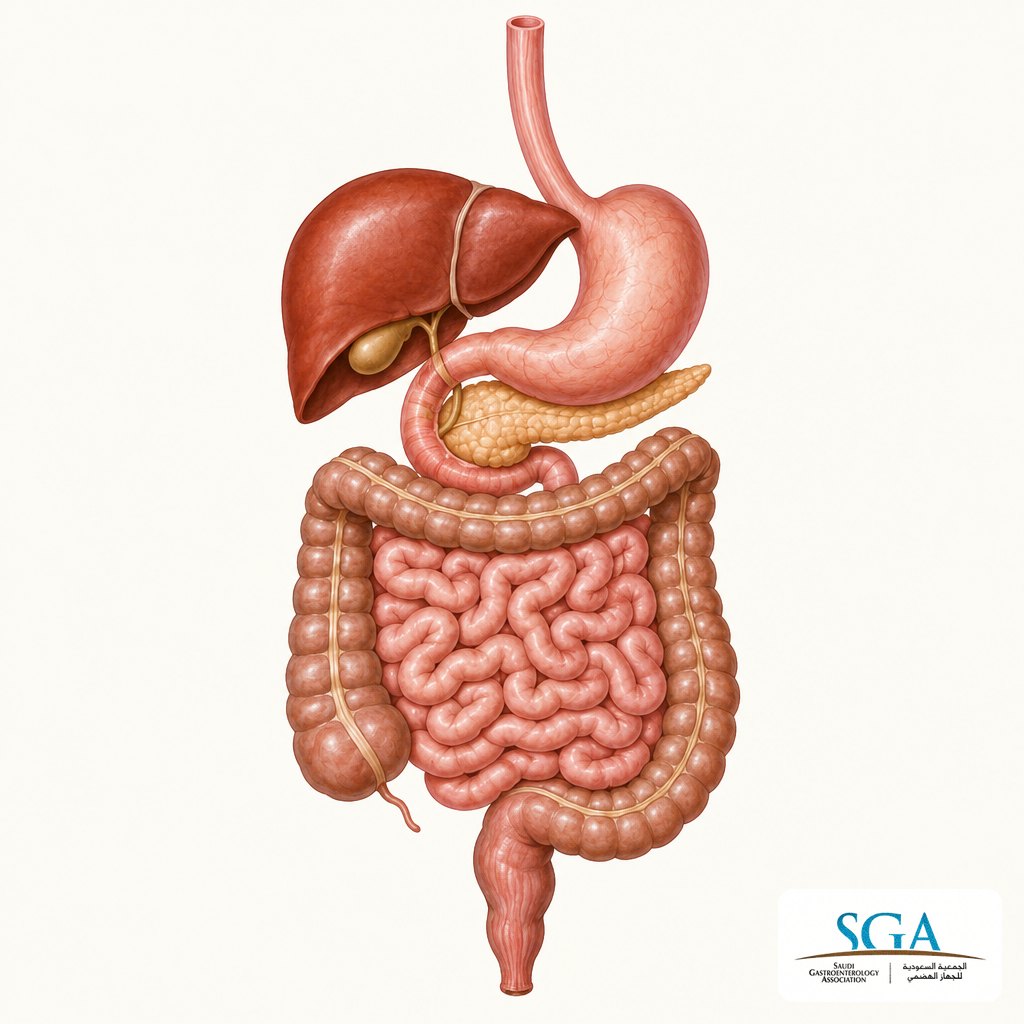
Caustic (corrosive) substances such as strong alkalis (drain and oven cleaners), strong acids (some toilet and rust cleaners), bleach, and button batteries can burn tissue on contact. Damage can affect the lips, mouth, throat, esophagus (food pipe) and stomach, and the burn can continue to deepen for hours. In children this is usually accidental; in adults it may be accidental or intentional. If the ingestion was intentional, emotional support and mental health care are needed alongside medical care.
How common is it?
Most cases involve young children who swallow household products by accident, and adults who mistake a chemical stored in an unmarked bottle for a drink. Serious injury can occur even when there are few symptoms at first.
Why does it happen?
Alkalis tend to cause deep burns of the food pipe, while acids more often injure the stomach. The harm depends on the type, strength and amount swallowed. Button batteries stuck in the food pipe can burn through the wall within a couple of hours and are a dire emergency. Chemicals kept in drink bottles or left within a child's reach are the commonest cause.
Symptoms
- Burning pain in the mouth, throat, chest or abdomen
- Drooling, difficulty or pain with swallowing, refusing to eat or drink
- Vomiting, sometimes with blood
- Hoarse voice, noisy breathing, or cough
- Redness, burns or swelling of lips and mouth (but absence of mouth burns does not rule out deeper injury)
- Chest or abdominal pain that gets worse
Red flags — seek urgent medical care
Any swallowing of a caustic or unknown chemical, even with no symptoms
Go to the emergency room or call emergency services now. Take the container or bottle with you. You can also call the poison center.
Difficulty breathing, noisy breathing, or swelling of the lips, tongue or throat
The airway may be closing. Call emergency services immediately.
Severe chest or abdominal pain, or a rigid belly
The wall of the food pipe or stomach may have been perforated. Emergency.
Swallowing a button (disc) battery
Can cause severe burns within hours. Go to the ER immediately, even if there are no symptoms.
A baby or child who has swallowed any chemical, is drooling, refusing feeds, or crying with pain
A baby or child needing urgent care must be seen immediately at an emergency department.
How is it diagnosed?
The team will identify the product, quantity and time of swallowing, check airway, breathing and circulation, and take blood tests. X-rays or CT scans look for perforation. Endoscopy, a thin camera passed through the mouth to see the burn, is usually done within the first day if the patient is stable, and the grade of injury guides treatment and follow-up.
Outlook — what to expect
Mild burns often heal without lasting problems. Deeper burns can lead to scarring and narrowing (stricture) of the food pipe weeks to months later, causing swallowing difficulty that may need repeated dilation or surgery. Long-term follow-up is needed, because there is also a long-term increase in the risk of esophageal cancer after severe burns.
Treatment
Habits & Lifestyle
Act immediately: go to hospital. There is no safe home treatment.
- Call emergency services or go to the ER immediately; take the product container with you.
- Do NOT make the person vomit. This causes a second burn as the chemical comes back up.
- Do NOT give neutralizing agents such as vinegar or lemon juice, and do not give charcoal.
- If the chemical touched skin or eyes, rinse with plenty of clean running water for several minutes while getting help.
- Keep chemicals in their original labelled containers, locked and out of children's reach, and never in drink bottles.
Diet
Do not eat or drink anything until a doctor has assessed you.
- Small sips of water may be advised only by emergency staff or the poison centre; follow their instructions.
- In hospital, feeding is started once the injury is assessed; a feeding tube or intravenous nutrition may be needed for a time.
- Later, a dietitian guides the return to soft and then normal foods.
Medications
Medicines are chosen by the hospital team.
- Intravenous fluids and pain relief.
- Acid-reducing medicine to protect the injured lining.
- Antibiotics when infection or perforation is suspected.
- Use of steroids is not routine and is decided only by specialists.
Procedures & Surgery
Procedures assess the damage and treat complications.
- Endoscopy to grade the burn, usually in the first day or so if safe.
- Airway support or a breathing tube if the throat is swollen.
- Emergency surgery for perforation or dead tissue.
- Repeated dilation of strictures weeks later, or surgery if dilation fails.
- Button batteries lodged in the food pipe are removed urgently by endoscopy.
Questions to ask your doctor
Save this list or print it before your appointment — doctors appreciate prepared patients.
- How severe is the injury, and how likely is a narrowing later?
- When can I start eating and drinking?
- What symptoms should make me return, such as trouble swallowing?
- Will I need long-term endoscopy follow-up?
- How can I make our home safe from this happening again?
Was this guide helpful?
Status: Approved for publication by SGA; individual clinician review is ongoing · Published 24/04/2026
For general education only; it does not replace your doctor’s advice. Individual clinician review of this guide is ongoing. SGA clinician? Review this guide