

saudigastro.com/patients/balloon-enteroscopy
Results
The doctor will usually tell you what was seen once you are awake, or later the same day. If biopsies were taken, results usually take several days to a couple of weeks. Your doctor will explain what the findings mean and what comes next, such as treatment, surgery or further tests.
This article is educational and does not replace your doctor's advice. Seek urgent care for any red-flag symptoms.
What is it?
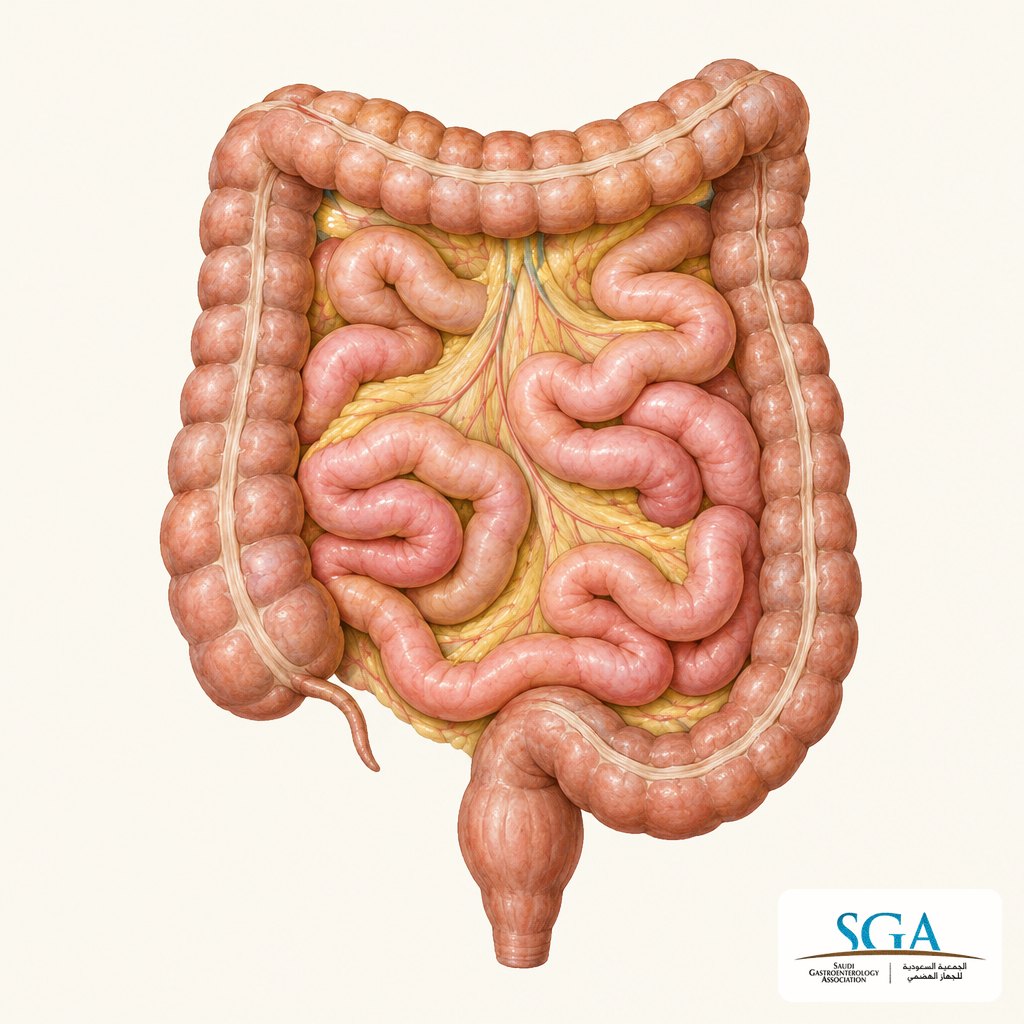
The small bowel (small intestine) is a long, winding tube between the stomach and the colon. A normal gastroscope or colonoscope reaches only the beginning or the very end of it. In balloon-assisted enteroscopy, the doctor uses a long, thin, flexible camera tube fitted with one or two small soft balloons (or a balloon on an overtube, a sleeve that slides over the scope). By inflating and deflating the balloons in turn, the doctor can grip the bowel wall and gently pleat the bowel onto the scope, like drawing a sleeve up an arm, so the camera can travel much deeper. It can be done through the mouth (antegrade) or through the anus (retrograde), and sometimes both are needed to see the whole small bowel. Tissue samples (biopsies) can be taken, and some problems can be treated during the same test.
Why is it done?
It is used when a problem is suspected in the small bowel that other tests have not explained or cannot treat. Common reasons are bleeding from the gut when gastroscopy and colonoscopy are normal (often called obscure bleeding), a growth, ulcer or narrowing seen on a scan or on a capsule camera test, and checking or treating small bowel Crohn’s disease. During the test the doctor can take biopsies, stop bleeding from abnormal blood vessels, remove polyps, stretch a narrowing, or remove a stuck capsule. It can also be used to reach the bile ducts or stomach outlet in people whose anatomy has been changed by surgery.
Who needs it?
- People with gut bleeding or unexplained iron-deficiency anaemia (low blood count from low iron) when gastroscopy and colonoscopy do not show the cause
- People with a suspected abnormality in the small bowel on CT, MR enterography or a capsule camera test who need a biopsy or treatment
- People with Crohn’s disease affecting the small bowel, for a narrowing or ulcers
- People with inherited polyp syndromes who need small bowel polyps checked or removed
- Selected people whose gut anatomy was altered by surgery and who need access to the bile ducts
Before the procedure
- Your centre will give written instructions. For a test through the mouth you will usually need to stop eating and drinking for several hours; the centre will tell you the exact fasting times.
- For a test through the anus you will need a full bowel preparation (a strong laxative drink) so the bowel is clean. Follow the instructions exactly; a poorly cleaned bowel can make the test incomplete.
- Tell the team about all your medicines, especially blood thinners (warfarin, apixaban, rivaroxaban, clopidogrel, aspirin), iron tablets and diabetes medicines. Never stop them on your own; the team will tell you what to pause and when.
- Tell the team about allergies, heart or lung conditions, pregnancy, previous abdominal surgery and any earlier problems with sedation or anaesthesia.
- The test usually needs deep sedation or general anaesthesia, so you will need an adult to take you home and stay with you. If you are fasting for Ramadan, tell the team early so the timing can be planned safely.
During the procedure
You are asleep or deeply sedated and monitored throughout. You lie on your side or back. The doctor passes the scope through the mouth or the anus and advances it step by step using the balloons: the balloon grips the bowel, the scope is pulled back to straighten and gather the bowel, then the scope moves forward again. This is repeated many times, so the test takes longer than a normal scope, often one to two hours or more. Gas (often carbon dioxide, which the body absorbs quickly) is used to open the bowel. The doctor may take biopsies, treat bleeding points, remove polyps or stretch a narrowing. Sometimes the doctor places a tiny ink mark (tattoo) on the bowel lining to mark a spot for later surgery or for a second examination from the other direction. You will not feel the test while sedated.
After the procedure
You wake up in the recovery area and are watched until the sedation wears off. Bloating, wind and mild cramping are common for a day or so; passing gas helps. A mild sore throat can occur after a test through the mouth. You may be asked to wait before eating, then restart with small light meals. Do not drive, sign legal papers or make important decisions for the rest of the day. If a treatment such as polyp removal or stretching was done, you may be kept for observation or told to avoid certain medicines for a while. Your team will tell you when to restart blood thinners and other medicines.
Risks
- Bloating, belly discomfort and sore throat (common and short-lived)
- Inflammation of the pancreas (pancreatitis) after a test through the mouth, which causes upper belly pain and is uncommon
- Bleeding, especially after a biopsy, polyp removal or treatment of blood vessels (usually settles by itself or is treated at once)
- A tear (perforation) in the bowel wall, which is rare but serious and may need surgery. The risk is higher when treatments such as stretching or polyp removal are done.
- Reactions to sedation or anaesthesia, including breathing or heart problems, rare
- The test may not reach the whole small bowel or may not find a cause, so another test or a second approach may be needed.
- Go to the emergency department promptly if, after the test, you have severe or worsening belly pain, a swollen hard belly, fever or chills, repeated vomiting, black or bloody stools, or dizziness or fainting.
When you get results
Alternatives if you decline
Other ways to look at the small bowel include capsule endoscopy (swallowing a tiny camera), CT or MR enterography (scans), and sometimes surgery with an on-table endoscopy. The main advantage of balloon-assisted enteroscopy is that it allows biopsies and treatment as well as viewing. A capsule or scan is often done first because they are less invasive but cannot treat. If you decline the test, a problem such as ongoing bleeding or a growth could stay undiagnosed or untreated. Your doctor will help you choose.
Questions to ask your doctor
Save this list or print it before your appointment — doctors appreciate prepared patients.
- Why do I need this test, and would a capsule camera or scan be enough first?
- Will it be done through the mouth, the anus or both?
- Will I be under general anaesthesia, and how long will I stay?
- Which of my medicines should I pause, and for how long?
- What treatments might be done during the test, and what are the risks of those?
Was this guide helpful?
Status: Approved for publication by SGA; individual clinician review is ongoing · Published 24/04/2026
For general education only; it does not replace your doctor’s advice. Individual clinician review of this guide is ongoing. SGA clinician? Review this guide