

saudigastro.com/patients/acute-cholecystitis
Category
Serious
Red flags
5
This article is educational and does not replace your doctor's advice. Seek urgent care for any red-flag symptoms.
What is it?
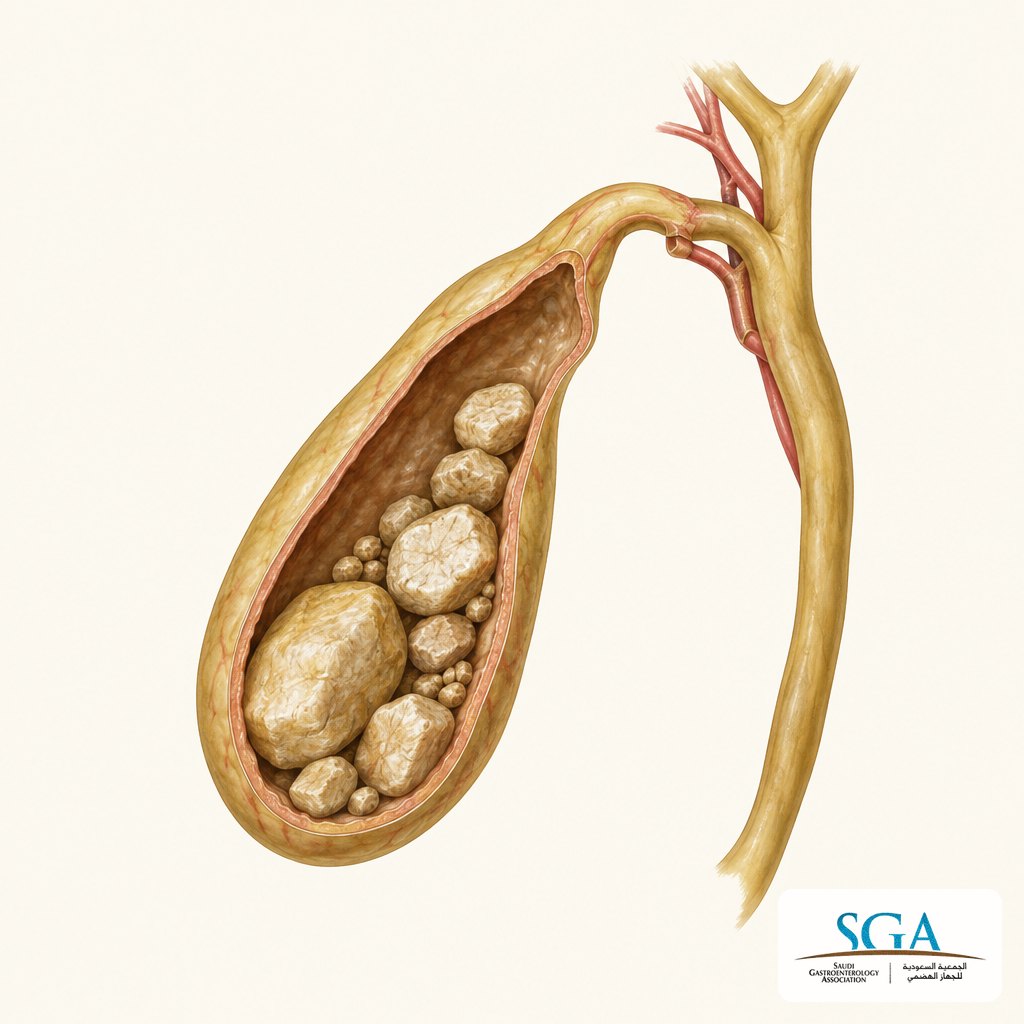
The gallbladder is a small pouch under the liver that stores bile, a digestive fluid made by the liver that helps the body digest fat. Acute cholecystitis (say "KOH-lee-sis-TIE-tis") means the gallbladder wall has suddenly become inflamed and swollen. It is usually a complication of gallstones. Because the inflamed gallbladder can become infected or, rarely, burst, this is a condition for hospital assessment and not for waiting at home.
How common is it?
Gallstones are common in adults, and acute cholecystitis is one of the most frequent reasons for emergency surgery assessment worldwide. It is more likely in people who already have gallstones, and the risk of gallstones is higher in women, with pregnancy, obesity, rapid weight loss and older age.
Why does it happen?
In most people a gallstone becomes stuck in the narrow duct leading out of the gallbladder. Bile then builds up, pressure rises, and the wall becomes inflamed, and bacteria can follow. Less often, inflammation happens without stones (acalculous cholecystitis), usually in people who are already very ill, for example after major surgery, burns, or a long stay in intensive care.
Symptoms
- Steady, severe pain in the upper right belly (or the upper middle) lasting more than a few hours
- Pain that may spread to the right shoulder or the back
- Fever and chills
- Nausea and vomiting
- Tenderness when the upper right belly is pressed
- Loss of appetite and feeling generally unwell
- Often follows a heavy or fatty meal, but can start at any time
Red flags — seek urgent medical care
Severe belly pain with fever or shaking chills
This is the typical picture of an inflamed or infected gallbladder. Go to the emergency department now. Do not wait to see if it settles.
Yellow skin or eyes, dark urine or pale stools
A stone may be blocking the main bile duct, which can cause a serious infection of the bile ducts. Emergency care is needed.
Pain that suddenly spreads across the whole belly, a rigid belly, or a racing heart with dizziness
Could mean the gallbladder has perforated (burst) or that you are becoming seriously unwell. Call emergency services immediately.
Repeated vomiting so that you cannot keep fluids down
Risk of dehydration. You need to be assessed and may need fluids through a drip.
Diabetes, older age or a weak immune system together with any of the above
Symptoms may be milder than expected while the illness is still serious, so seek care earlier.
How is it diagnosed?
Your doctor will examine your belly and ask about the pain. Blood tests look for signs of infection and for liver and bile duct involvement. An ultrasound of the abdomen is usually the first scan and can show gallstones, a thickened gallbladder wall and fluid around it. If the picture is unclear, further imaging such as a CT scan, an MRI of the bile ducts (MRCP) or a nuclear scan of the gallbladder may be used. The doctor decides which tests are right for you.
What the latest science says
Current guidance generally favours removing the gallbladder by keyhole surgery during the same hospital stay, or soon after the first attack, for people who are fit for surgery. Timing and approach are individual decisions, especially for older or frail patients, who may first be treated with drainage.
Outlook — what to expect
Most people recover well after treatment, particularly when the gallbladder is removed. Delay in treatment increases the chance of complications such as infection spreading or perforation. You can live a normal life without a gallbladder, because the liver keeps making bile and it flows directly into the intestine.
Treatment
Habits & Lifestyle
This is an emergency condition, so there is no home treatment. What you do before and after hospital care matters.
- Go to the emergency department if you have severe upper right belly pain with fever
- Do not eat or drink while waiting to be seen, as you may need surgery or a scan
- Do not take extra pain medicines or herbal remedies to "push through" the pain
- Tell the team about all your medicines, especially blood thinners and diabetes medicines
- After discharge, follow your surgeon's advice on activity and wound care
Diet
In hospital you may be asked to stop eating for a time. Afterwards, food advice is mostly about comfort.
- Follow the fasting instructions given by the hospital team
- After recovery, start with light, small meals and add normal foods gradually
- Very fatty or fried meals may cause loose stools or discomfort for a while after gallbladder removal; most people can return to a normal balanced diet
- A healthy weight and steady eating pattern lower the risk of further gallstone problems
Medications
Medicines support treatment but do not replace dealing with the gallbladder itself. Your doctor decides what you need.
- Antibiotics, usually given through a vein, treat or prevent infection
- Intravenous fluids keep you hydrated while you cannot eat
- Pain relief is given in hospital; the team chooses a safe option for you
- Medicines to dissolve stones are not a treatment for an acute attack
Procedures & Surgery
Treatment of the gallbladder itself is usually a procedure.
- Laparoscopic cholecystectomy (keyhole removal of the gallbladder) is the usual definitive treatment
- Open surgery is occasionally needed if the keyhole approach is unsafe
- Percutaneous drainage (a thin tube placed through the skin into the gallbladder) may be used for people too unwell for surgery
- ERCP (a scope procedure) is used if a stone has moved into the main bile duct
Living with the condition
- Most people return to normal activities within days to a few weeks after keyhole surgery; your surgeon will advise you.
- Contact your doctor if pain, fever, yellow skin or wound redness appears after surgery.
Questions to ask your doctor
Save this list or print it before your appointment — doctors appreciate prepared patients.
- Do I need my gallbladder removed, and how soon?
- Are there signs that the stone has moved into the bile duct?
- Which of my regular medicines should I continue or hold around the time of surgery?
- How long will recovery take and when can I return to work?
- What should I eat after the gallbladder is removed?
Trusted resources
Was this guide helpful?
Status: Approved for publication by SGA; individual clinician review is ongoing · Published 24/04/2026
For general education only; it does not replace your doctor’s advice. Individual clinician review of this guide is ongoing. SGA clinician? Review this guide